Chair Exercises for Seniors: 12 Moves and a Free Printable
By Kristen Nielsen, Founder & Senior Fitness Specialist · Updated · 8 minute read
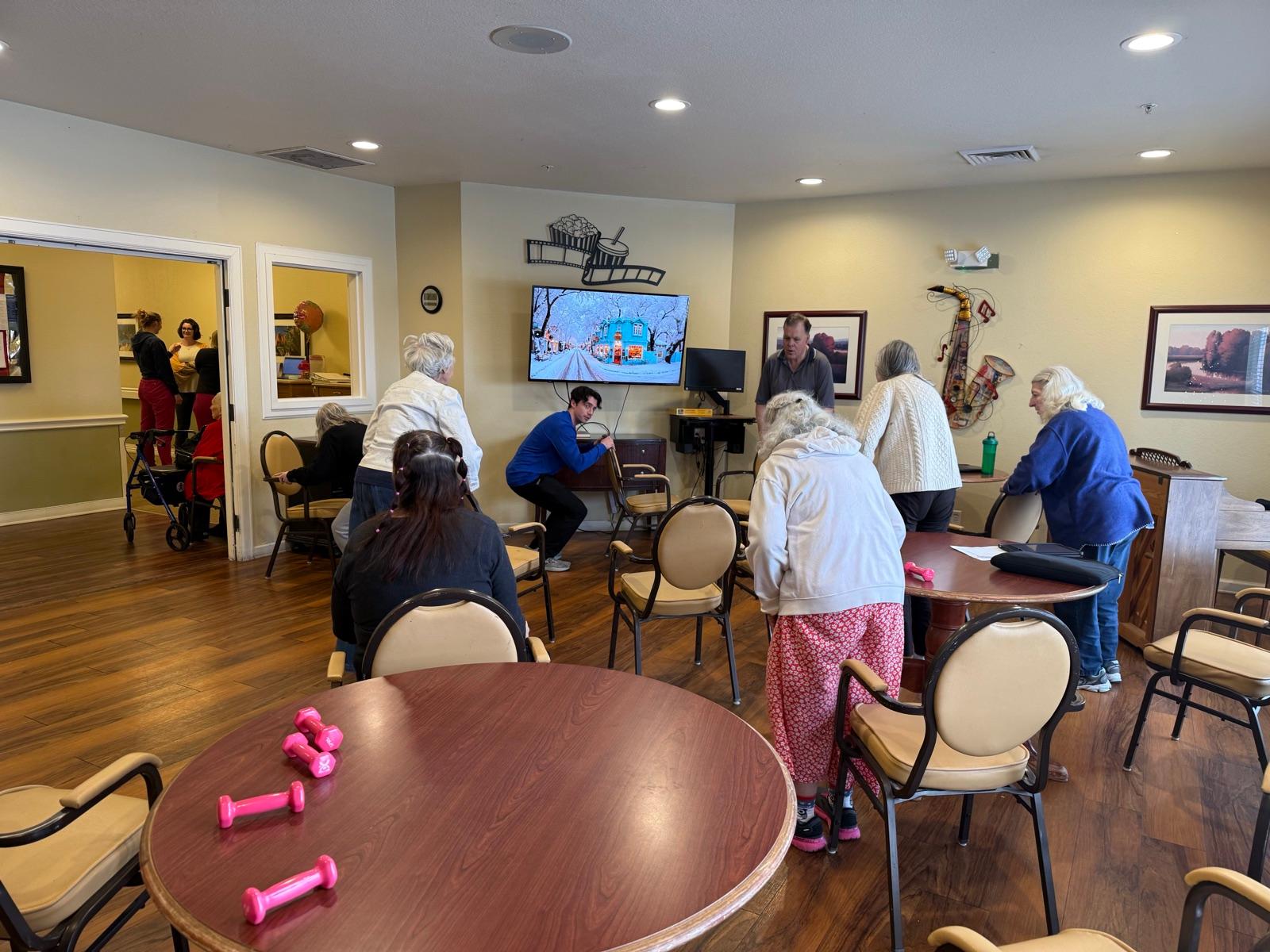
Chair exercises let you build real strength in a safe, supported way. Do a mix of seated moves (marching, leg extensions, band presses and rows) and standing moves holding the chair (sit-to-stands, heel raises and balance holds), 2–3 times a week. Make the last few reps of each feel hard, and add standing balance work as you get steadier.
Key takeaways
- Chair exercises build real strength. In a review of 19 studies, chair-based programs improved grip, arm and leg strength in older adults.
- Seated work alone didn't clearly improve balance or falls, so add standing moves with the chair for support as soon as you safely can.
- Aim for 2–3 sessions a week, with the last few reps of each strength move feeling hard.
- Put the moves together in a 15-minute routine, and make it harder over time by slowing down, adding resistance or moving from seated to standing.
Chair exercises let you build real strength in a safe, supported way, whether you do every move seated or use the chair to hold on while you stand. Below are the 12 chair moves I come back to most and a 15-minute routine you can print. If you're new to exercise, this is a good place to begin, and our guide to strength training for seniors is the next step.
A chair is one of my favorite pieces of exercise equipment. It's in every home, it costs nothing, and it gives you something steady to hold, which takes away a lot of the worry that keeps people from starting. It's also exactly what our trainers use in the senior living classes they lead, where residents work seated, standing with support or on their own, whichever is right for them that day.
Do Chair Exercises Really Work?
They do, with one honest caveat.
A review that pooled 19 studies of chair-based exercise in older adults found real gains in strength: better grip strength, more arm curls in 30 seconds and more chair stands in 30 seconds.1 Seated exercise has also been found safe and practical for people in care homes, including people who can't walk,2 and seated resistance band programs improved strength and everyday function in long-term care residents.3
The caveat is balance. In that same review, chair-based programs didn't clearly improve balance, walking speed or falls.1 That makes sense: balance improves when you practice balancing, and that means being on your feet.
So here's how I'd use this guide:
- If standing isn't safe for you yet, do the seated moves. They build strength you'll use every day.
- If you can stand with something to hold, do both. The standing moves, with the chair for support, are where balance comes in.
Not sure where you're starting? The 30-second chair stand test takes a minute and shows how your leg strength compares with others your age.
Seated Chair Exercises
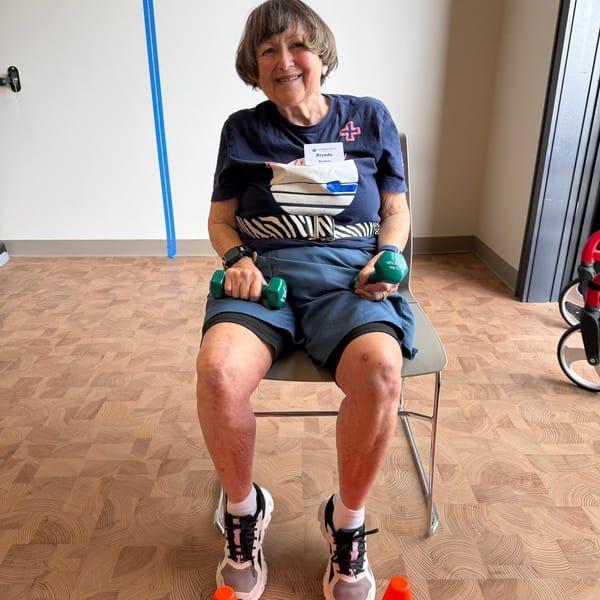
Sit toward the front of the chair, feet flat and hip-width apart, chest tall. Try not to lean back into the chair: sitting tall is part of the exercise.
Seated March
1 minute
- Sit tall toward the front of the chair with both feet flat.
- Lift one foot, then the other, as if you're marching.
- Keep your posture upright and avoid leaning back.
- Make it easier
- Lift your feet just an inch or two, and hold the sides of the seat.
- Make it harder
- Lift your knees higher and pump your arms, or add the number-and-letter rules from the Rule-Switch March.
Turn this into a brain workout by saying a number every time your right foot lifts and a letter every time your left foot lifts, then switching the rules after 20–30 seconds. That's my Rule-Switch March.
Ankle Pumps
30 seconds each foot
- Sitting tall, lift one foot slightly off the floor.
- Gently point your toes away from you, then pull them back toward your shin.
- Keep it smooth and steady, then switch feet.
- Make it easier
- Do both feet together, more slowly.
- Make it harder
- Add slow ankle circles in each direction afterward.
Seated Leg Extension
10 each leg
- Sit tall in the chair.
- Slowly lift one foot, straightening your leg.
- Hold for 3 seconds, then lower with control.
- Make it easier
- Straighten your leg only partway, and skip the hold.
- Make it harder
- Hold for 5 seconds, or add a light ankle weight.
This one strengthens the quadriceps, the muscles on the front of your thighs that help steady and protect your knees. It's one of my 3 daily moves to protect your joints.
Seated Glute Squeeze
10–15, holding 3–5 seconds
- Sit tall at the edge of a chair, feet flat, shoulders relaxed.
- Squeeze your buttocks together as if lifting yourself slightly off the seat (don't actually move).
- Hold for 3–5 seconds, then relax.
- Make it easier
- Hold for just 2 seconds.
- Make it harder
- Hold for 10 seconds, or squeeze while you do a seated march.
Your glutes are your body's engine for standing up, climbing stairs and catching yourself after a stumble. More in glute exercises for seniors.
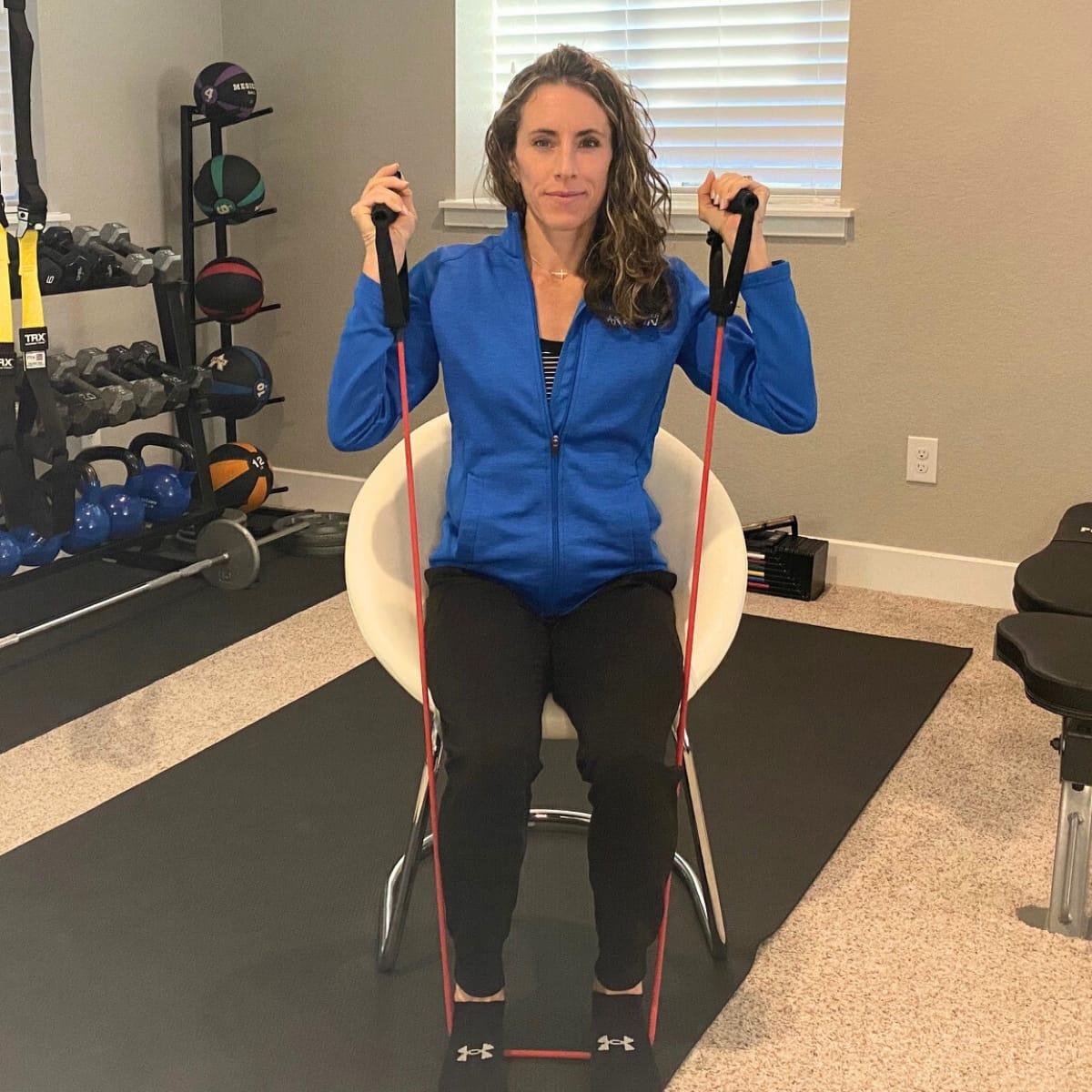
Seated Band Press
8–10, 2–3 rounds
- Sit with your feet flat and a resistance band under both feet, holding one end in each hand at shoulder height.
- Keeping your core engaged and back straight, press both hands overhead until your arms are straight.
- Lower slowly back to shoulder height.
- Make it easier
- Use a lighter band, or press one arm at a time.
- Make it harder
- Use a stronger band, or stand up as you press for a sit-to-stand press.
Seated Band Row
8–10, 2–3 rounds
- Sit tall and loop the middle of a resistance band around the soles of your feet, holding one end in each hand, arms reaching forward.
- Pull your elbows back past your sides, squeezing your shoulder blades together.
- Return slowly. Don't let the band snap back.
- Make it easier
- Hold the band farther from your feet so it's looser.
- Make it harder
- Choke up on the band, or pause for 2 seconds with your shoulder blades squeezed.
Rows strengthen the upper back, which helps you sit and stand taller. If you want to choose a band, my resistance band exercises for seniors post explains which kind to buy.
Standing Exercises Using a Chair
Now the chair becomes your support. Stand behind it and hold the top of the chair back, or stand beside it with one hand on it. A kitchen counter works too. As you get steadier, try holding on with just your fingertips, then hovering your hand above it.
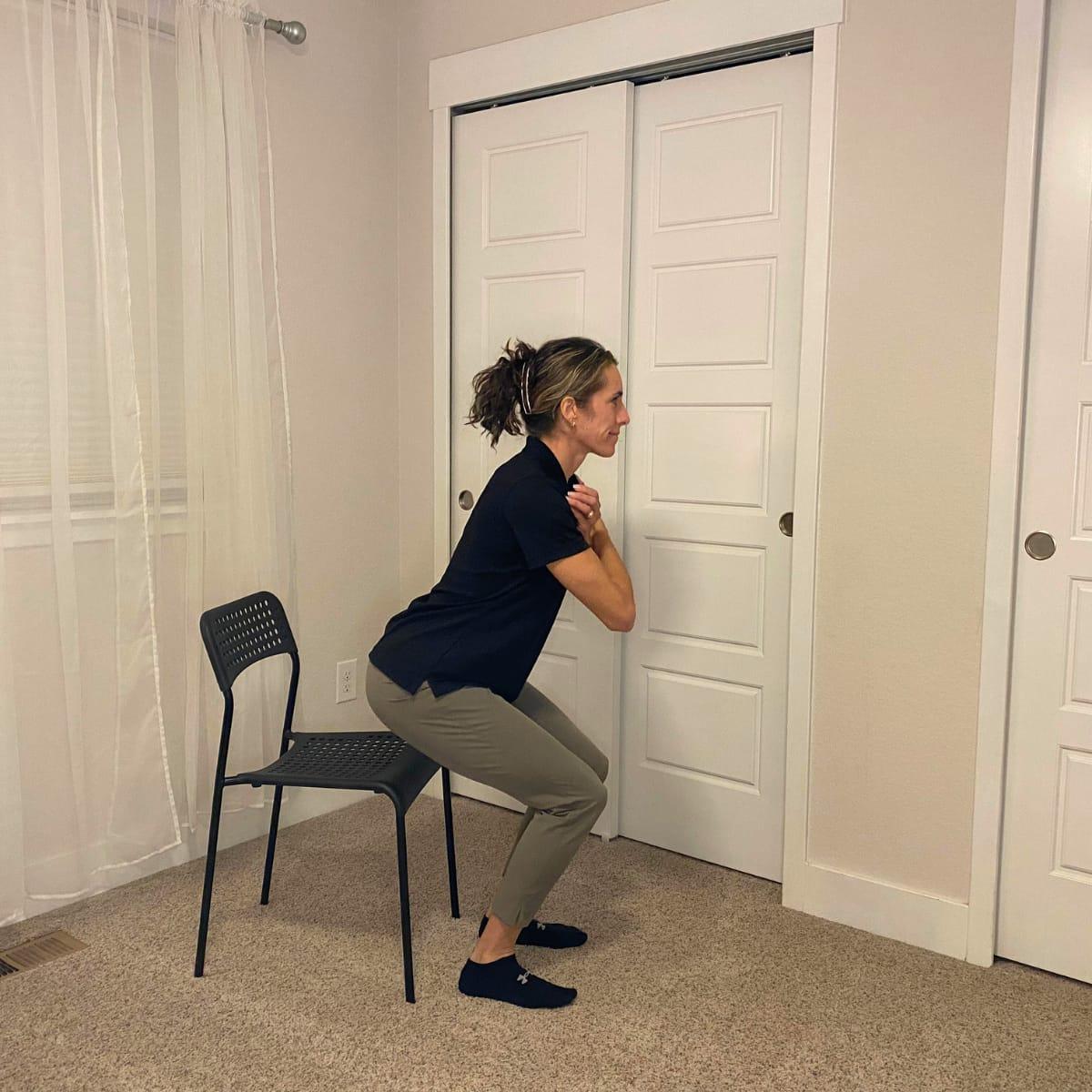
Sit-to-Stand
8–10, 2–3 rounds
- Sit toward the front of a sturdy chair, feet flat and shoulder-width apart.
- Engage your core and press through your heels to stand up, keeping your back straight. Think "glutes first."
- Stand all the way up.
- Slowly lower yourself back down with control. Don't collapse into the chair.
- Make it easier
- Push off the chair or its armrests with your hands, or use a higher seat.
- Make it harder
- Cross your arms, hold a heavy object at your chest, or lower more slowly.
If I had to pick one strength exercise for most people over 60, this would be it. It's the movement you need to get up from a chair, a bed, the car or the toilet. Even in nursing homes, residents with dementia who practiced sit-to-stands every day kept their ability to stand up and declined more slowly in daily function than those who didn't.6
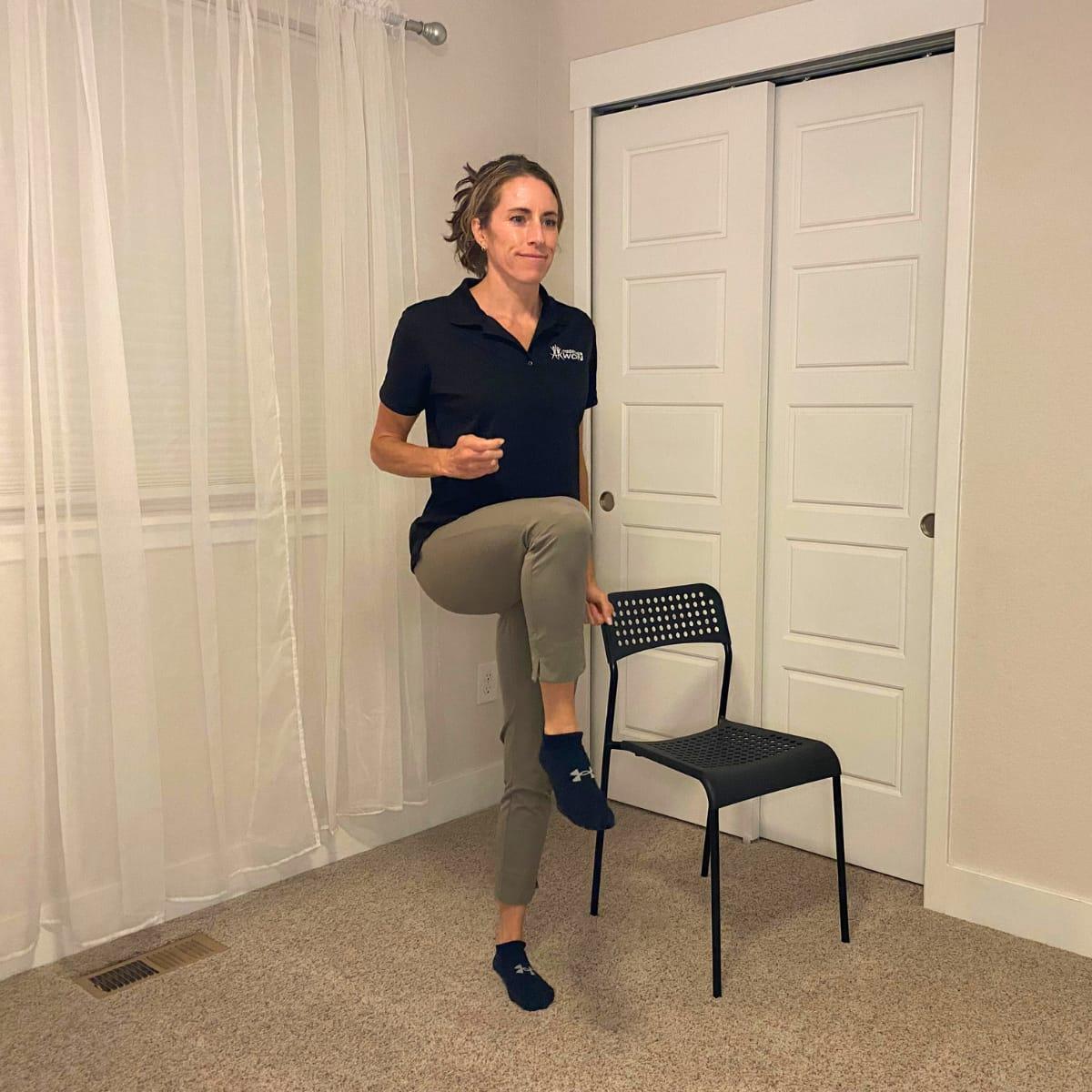
Standing March
30 seconds
- Stand tall, holding the chair back.
- Lift one knee as high as is comfortable, then lower it.
- Repeat with the other leg, like marching in place.
- Make it easier
- Hold on with both hands and keep the knee lifts low.
- Make it harder
- Lift your knees higher and hold each one for a second, or loosen your grip on the chair.
Heel Raises
10–15
- Stand tall behind the chair, holding the back, feet hip-width apart.
- Rise up onto the balls of your feet.
- Pause, then lower your heels slowly.
- Make it easier
- Rise only partway, and hold on with both hands.
- Make it harder
- Pause for 2 seconds at the top, or lower very slowly.
Strong calves help you push off when you walk and recover when you trip.
Side Leg Raise
8–10 each leg
- Stand tall behind the chair, holding the back.
- Keeping your toes pointing forward and your body upright, lift one leg out to the side.
- Lower slowly, without leaning toward the chair. Switch legs.
- Make it easier
- Make the lift smaller.
- Make it harder
- Hold the top for 2 seconds, or add a light ankle weight.
This strengthens the muscles on the side of your hip that keep your pelvis level each time you're on one foot, which is a big part of walking steadily.
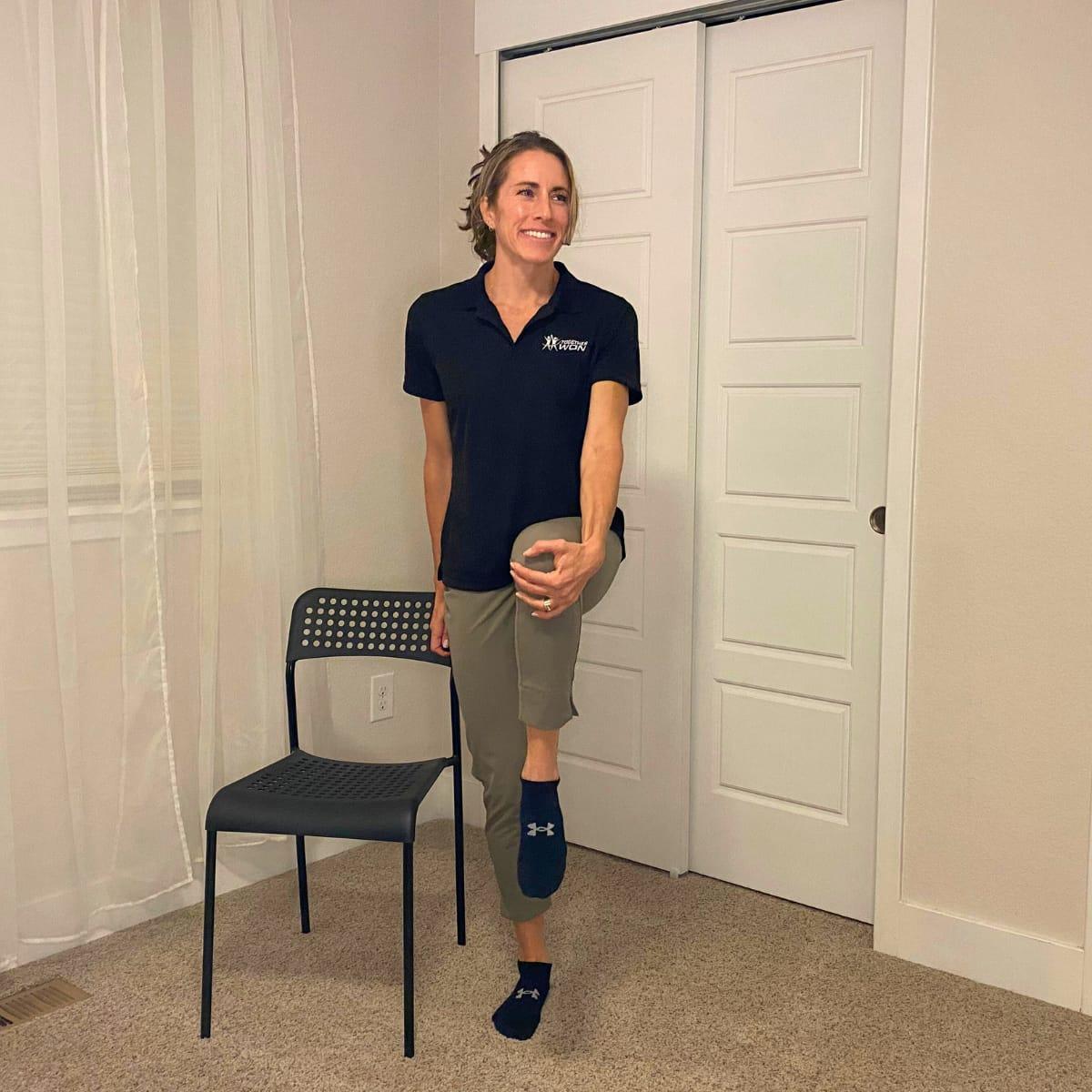
Single-Leg Stand
10–30 seconds each side
- Stand next to the chair, holding it for balance if needed.
- Lift the knee farthest from the chair and hold it with your free hand.
- Hold, then switch sides. Gradually reduce your support.
- Make it easier
- Keep a light hand on the chair, and lift your foot just off the floor.
- Make it harder
- Hover your hand above the chair, then try it without holding on.
These standing moves are the start of real balance training. When you're ready for more, my balance exercises for seniors guide walks through the next steps, and the 4-stage balance test shows where you're starting.
Add a Thinking Task
Once a move feels easy, give your brain something to do at the same time. Real life rarely lets us move without thinking, and practicing both together is good for your balance and your brain.
Try counting sit-to-stands: stand up and sit down with control while counting backward from 100 by 3s, for 10 repetitions. For a bigger challenge, count backward by 4s. You'll find more ideas in our guide to exercise for brain health and in dual-task walking exercises.
How Do You Cool Down After Chair Exercises?
Finish with a gentle twist and a few slow breaths. It loosens your back after all that work and brings your heart rate down.
Seated Twist
1 minute, then 6 slow breaths
- Sit tall with your feet flat and knees together.
- Place your right hand on your left knee and your left hand on the side or back of the chair.
- Breathe in to sit tall, then breathe out as you turn gently to the left. Come back to center and switch sides.
- Make it easier
- Turn only your head and shoulders.
- Make it harder
- Hold each twist for three slow breaths.
Then finish with the 4–6 breath: inhale through your nose for 4 seconds and exhale through your mouth for 6 seconds, for 6–10 breaths. Calmer breathing often leads to steadier balance. Read more about how breathing affects balance, and for more stretches you can do from a chair, see stretching for seniors.
A 15-Minute Chair Routine to Print
Here's how I'd put it together. Do the moves in order once (about 12 minutes), then repeat any two you most want to get better at. Seated moves come first to warm you up; standing moves follow while you're fresh enough to balance well.
The 15-minute chair routine
about 15 minutes
- Seated March1 minute
- Ankle Pumps30 seconds each foot
- Seated Leg Extension10 each leg
- Seated Glute Squeeze10–15 squeezes
- Seated Band Press8–10
- Seated Band Row8–10
- Sit-to-Stand8–10
- Standing March30 seconds
- Heel Raises10–15
- Side Leg Raise8–10 each leg
- Single-Leg Stand10–30 seconds each side
- Seated Twist1 minute, then 6 slow breaths
free to print
The 15-minute chair exercise routine
The whole routine on one page with a box to tick each day, plus a page of step-by-step instructions. Tape it to the fridge.
PDF · 2 pages · 232 KB
Want a new idea like this every Saturday? Optional, and free.
If you can't stand safely yet, do just the seated moves and the cool-down, twice through.
How Often Should Seniors Do Chair Exercises?
Aim for 2–3 sessions a week, with a rest day between your harder strength days. That matches national guidelines, which recommend muscle strengthening on at least two days a week and a mix of aerobic, strength and balance activity for older adults.4,5 On the other days, a few minutes of the seated march and ankle pumps, or a short walk, keeps you moving.
The national guidelines also say something I love: if you can't reach the full recommendations, be as physically active as your abilities and conditions allow.4 Ten minutes in a chair counts.
How Do You Make Chair Exercises Harder?
To keep getting stronger, the work has to stay challenging. For strength moves, choose a version where the last two or three reps of each set feel hard. If you could easily do 20 more, it's time to progress:
- Slow down. Take three seconds to lower in each move.
- Add resistance. Use a stronger band, light dumbbells or a water bottle.
- Add a round. Go from 2 rounds to 3.
- Stand up. Move from the seated version to the standing one, and from two hands on the chair to one, then to fingertips.
- Retest. Try the chair stand test every four to eight weeks with the same chair.
Muscle fatigue is expected. Sharp pain, joint pain, dizziness, numbness or feeling unsteady are signs to stop or modify. My post on how hard seniors should strength train explains how to find the right effort.
When Is It Time for More Help?
If getting up from a chair is already hard, or you've had a fall, a recent surgery or a new diagnosis, it's worth having someone set this up with you. A physical therapist is the right first step after an injury or surgery (our trainer or physical therapist guide explains the difference). After that, our trainers, who specialize in exercise for older adults, can come to your home in the Colorado Springs and Tri-Lakes area, or coach you online, and build a program around where you are today.
This guide is for general education and isn't medical advice. Please talk with your doctor before starting a new exercise, nutrition or supplement routine.
Read more from Kristen

Body
3 Daily Moves to Protect Your Joints as You Age
Exercise is one of the best tools for easing arthritis symptoms. Try these 3 simple daily moves for your knees, hips and ankles, plus a hydrating snack.
May 24, 2025 · 3 min read
Balance · Body
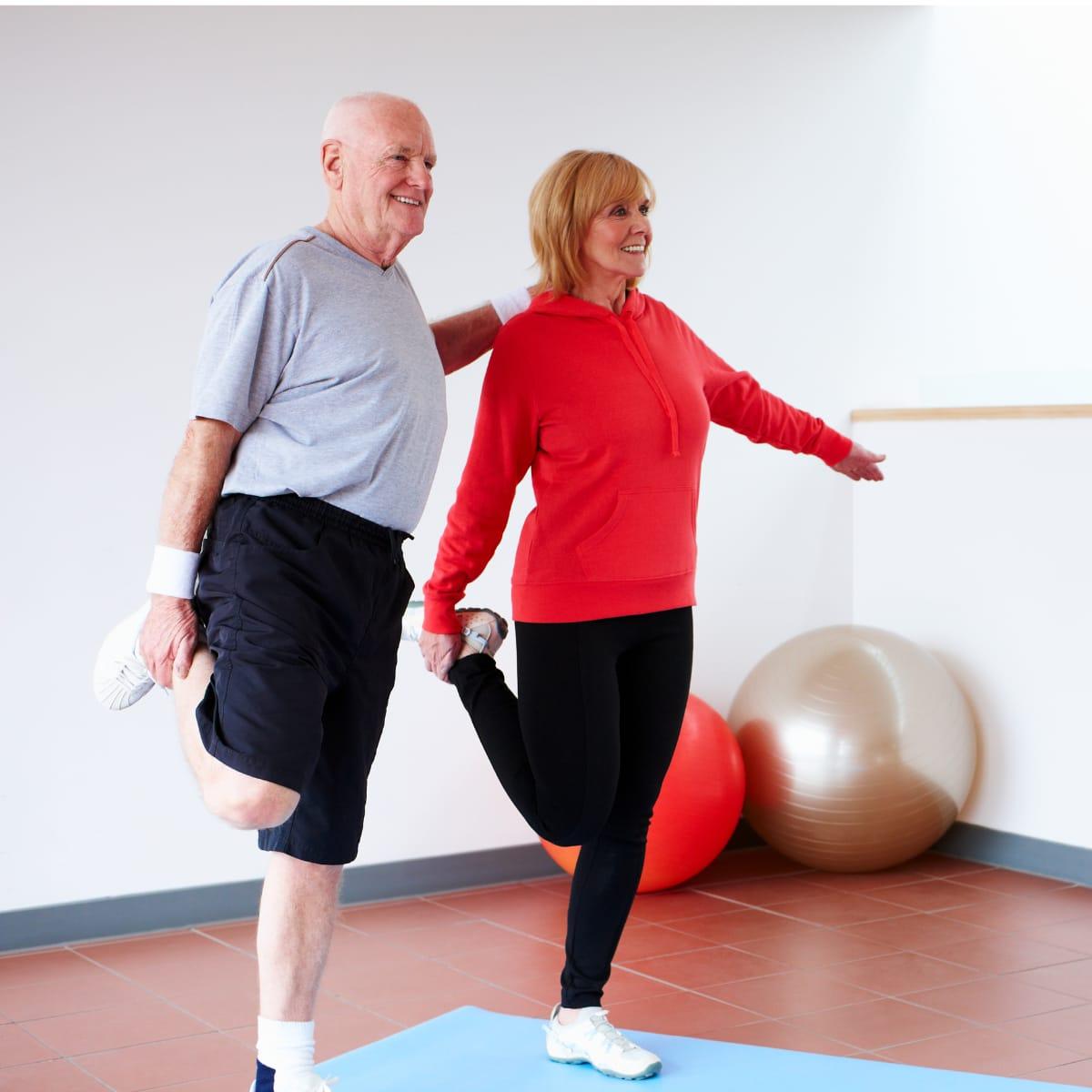
4 Easy Balance Exercises to Practice 2–3 Times a Week
One in four adults over 65 falls each year. Four simple balance exercises to practice two to three times a week, plus how medications can affect balance.
November 9, 2024 · 3 min read

Body · Balance
Glute Exercises for Seniors: Why Strong Glutes Matter
Strong glutes protect your back and knees, steady your balance and make stairs easier. Try the seated glute squeeze and a "glutes first" habit.
November 8, 2025 · 2 min read
Body
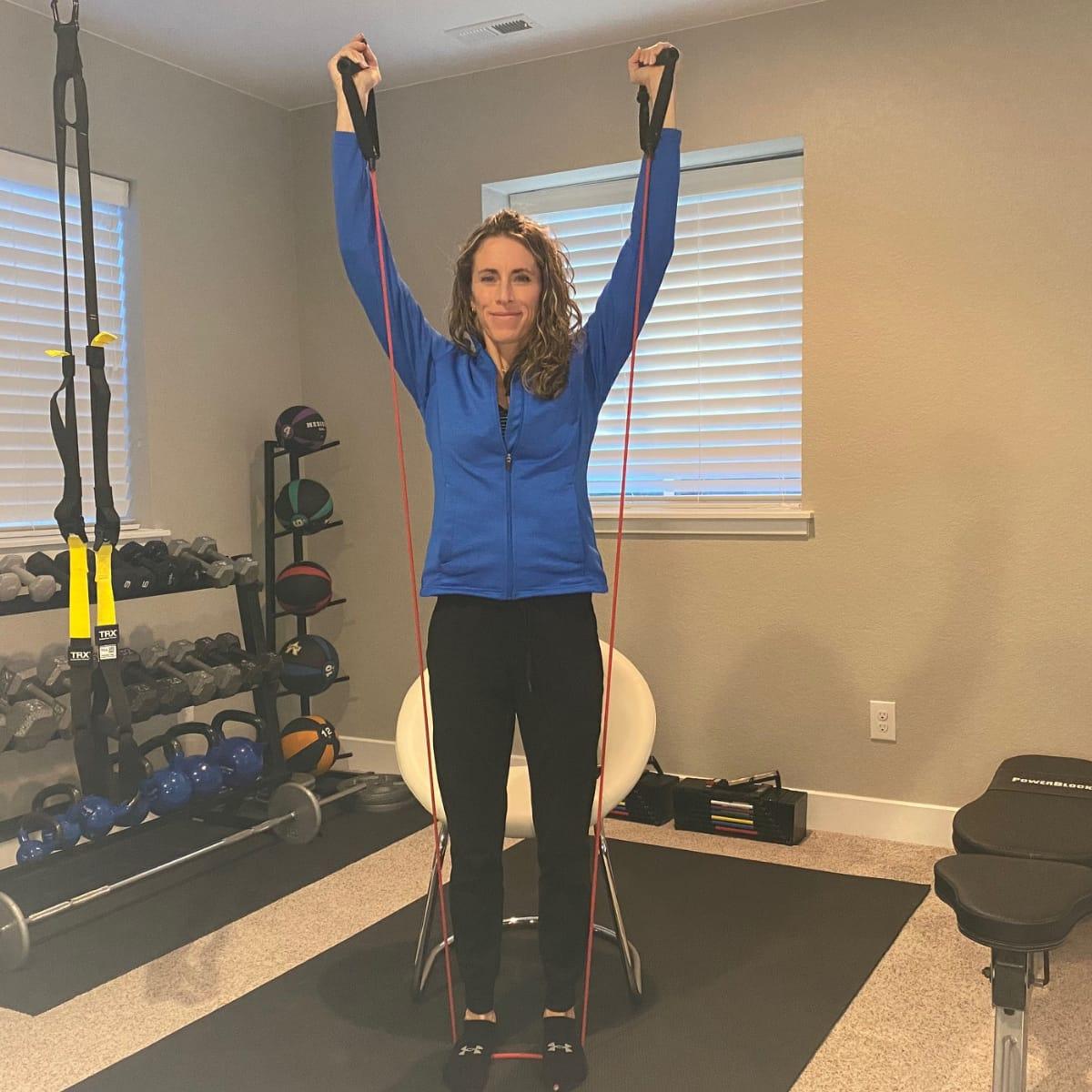
Resistance Band Exercises for Seniors
Resistance bands are cheap, portable and joint-friendly. What kind to buy, plus three step-by-step band exercises for strength, balance and rotation.
November 23, 2024 · 5 min read

Brain · Body
Brain-Body Exercises for Seniors: The Rule-Switch March
Brain-body exercises pair movement with a mental challenge. Try the Rule-Switch March, a simple standing or seated drill for focus and balance.
July 11, 2026 · 3 min read

Body · Balance
Exercise Snacks for Seniors: 5-Minute Movement Breaks
Short 1–5 minute bursts of movement through the day add up. What the research says, plus three 5-minute snack routines for morning, midday and evening.
April 19, 2025 · 4 min read
Frequently asked questions
Can chair exercises build muscle?
Yes, as long as they're challenging. Muscles grow when they're asked to do more than they're used to, whether you're sitting or standing. In reviews of chair-based programs, older adults gained grip, arm and leg strength, including people living in care homes who exercised with resistance bands.
The key is effort. Use a band or light weights for the arm moves, slow the movements down, and choose a version where the last two or three reps of each set feel hard.
Are chair exercises enough exercise on their own?
They're a wonderful start, and on a low-energy day they're far better than nothing. But national guidelines call for a mix of aerobic, strength and balance activity for older adults, and seated work alone didn't clearly improve balance in the research.
As you get stronger, add the standing moves with the chair for support, short walks, and the balance exercises in our balance guide.
What kind of chair should I use for chair exercises?
A sturdy, straight-backed chair without wheels, about the height of a dining chair, with the back against a wall so it can't slide. Armrests are fine for seated moves and helpful while you're learning sit-to-stands.
Avoid recliners, rockers, folding chairs and anything that tips or rolls. For standing moves, hold the top of the chair back, or use a kitchen counter instead.
Can I do chair exercises if I can't stand up safely?
Yes. Every seated move in this guide can be done without standing, and seated programs have been found safe and practical even for people who can't walk. Work with the seated moves, and ask your doctor or a physical therapist when it's safe to add standing.
Sources
- Klempel N, Blackburn NE, McMullan IL, et al. The effect of chair-based exercise on physical function in older adults: a systematic review and meta-analysis. Int J Environ Res Public Health. 2021;18(4):1902. doi:10.3390/ijerph18041902 View source
- Cordes T, Schoene D, Kemmler W, Wollesen B. Chair-based exercise interventions for nursing home residents: a systematic review. J Am Med Dir Assoc. 2021;22(4):733-740. doi:10.1016/j.jamda.2020.09.042 View source
- Efendi F, Tonapa SI, Has EMM, Ho KHM. Effects of chair-based resistance band exercise on physical functioning, sleep quality, and depression of older adults in long-term care facilities: systematic review and meta-analysis. Int J Nurs Sci. 2023;10(1):72-81. doi:10.1016/j.ijnss.2022.12.002 View source
- US Department of Health and Human Services. Physical Activity Guidelines for Americans. 2nd ed. HHS; 2018. View source
- National Institute on Aging. Three types of exercise can improve your health and physical ability. View source
- Slaughter SE, Wagg AS, Jones CA, et al. Mobility of Vulnerable Elders study: effect of the sit-to-stand activity on mobility, function, and quality of life. J Am Med Dir Assoc. 2015;16(2):138-143. doi:10.1016/j.jamda.2014.07.020 View source
This guide is for general education and isn't medical advice. Please talk with your doctor before starting a new exercise, nutrition or supplement routine. See our health disclaimer.

About the author
Kristen Nielsen
Kristen founded TogetherWON after watching what strength training could do for older adults — including her own grandparents. She's an ACE Certified Personal Trainer with 10+ years in functional aging, a University of Central Florida graduate, and a former Division I swimmer and track & field athlete.
Senior Fitness Specialist · Functional Aging Specialist · Parkinson's Disease Specialist · Brain Health Trainer · Corrective Exercise Specialist
want these in your inbox?
Get my Saturday letters
One idea for your body, brain or balance each week, usually with a recipe. Unsubscribe any time.