
Exercise for Parkinson’s disease in Colorado Springs

Exercise doesn’t cure Parkinson’s, but research shows that regular exercise improves motor symptoms and quality of life, and early evidence suggests challenging exercise may slow the worsening of motor symptoms.

TogetherWON founder Kristen Nielsen is a certified Parkinson’s Disease Specialist. She builds programs that train the body, brain and balance together, in your home in the Colorado Springs area or online.

Last updated

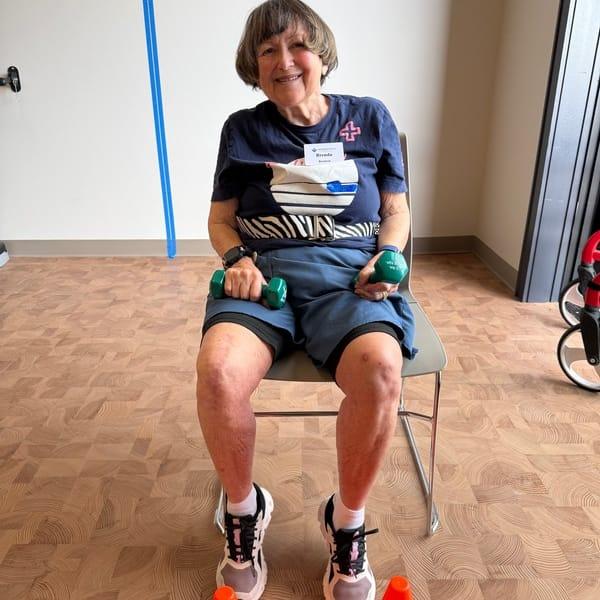
Brenda smiling in a chair holding two small green dumbbells, with cones at her feet

Body

Strength and aerobic work that’s challenging enough to make a difference, progressed safely, to counter smaller, slower movement.

Brain

Movement paired with coordination, attention and decision-making, to support the nervous system’s ability to adapt.

Balance

Thoughtful, progressive balance practice to improve stability, reduce fall risk and build confidence.

Symptoms and how we train for them

Parkinson’s affects everyone differently, so we match the training to what you notice day to day.

  • Smaller, slower movements

    Big, powerful movement

    Exercises that exaggerate step length and arm swing. Some trials suggest amplitude-focused training improves movement, though the evidence is still limited.5,2

  • Shuffling steps

    Rhythm and visual cues

    A steady beat or marks on the floor can help lengthen steps and speed up walking. Brenda’s sessions use music and cones.4

  • Balance changes

    Gait and balance training

    Practice turning, stepping and catching yourself. In the largest review of Parkinson’s exercise, gait and balance training was among the most helpful for motor symptoms.2

  • Trouble doing two things at once

    Walking while thinking

    Walking while talking, counting or carrying something. In a review of 17 trials, dual-task training improved walking speed, stride length and balance.6

  • Feeling slowed down

    Heart-pumping cardio

    In the SPARX trial, newly diagnosed people who exercised at 80–85% of their maximum heart rate held steady on motor symptoms for six months, while a wait-list group got worse.1

  • Stiffness

    Mobility and stretching

    Regular stretching and mobility work, which the Parkinson’s Foundation recommends at least 2 to 3 days a week.3

How much exercise the Parkinson’s Foundation recommends

These guidelines, developed with the American College of Sports Medicine, are the target we build toward, starting wherever you are today.

minutes a week of moderate-to-vigorous exercise3
150
a week of aerobic exercise, at least 30 minutes each3
3 days
a week of strength training, on non-consecutive days3
2–3 days
a week of balance, agility and multitasking, daily if possible3
2–3 days

How care partners can help

Family and care partners make a real difference in staying consistent. Here are simple ways to help.

  • Join a session to learn the exercises and how to spot safely
  • Help with short practice on the days between visits
  • Use music or counting to set a steady rhythm on walks
  • Notice good days and hard days, and let the trainer know
  • Cheer on the progress you see logged in the TogetherWON app

Care partners are always welcome at sessions.

This program is for

  • People recently diagnosed with Parkinson’s who want to start exercising early
  • People living with Parkinson’s or Parkinson’s-type symptoms at any stage
  • Anyone experiencing freezing, smaller steps or balance changes
  • Families and care partners who want to help a loved one stay active

How we work with Parkinson’s

  1. Understand your symptoms and goals

    Your free consultation covers how Parkinson’s affects you day to day and what you most want to keep doing.

  2. Train with effort, safely

    Research shows exercise helps most when it’s challenging and progressive, so we encourage real effort, never exhaustion.

  3. Adapt to good days and hard days

    Parkinson’s changes day to day. Your trainer adjusts every session for how your body is responding.

  4. Keep it consistent

    The benefits come from ongoing exercise, so we build a routine you can keep, with support from family where it helps.

One-on-one training starts at $198 a month, month to month, and your first one-hour consultation is free.

See plans and pricing

“Kristen is a picture of warmth and kindness mixed with knowledge and expertise… This program adjusts to the needs of clients based on injuries and lifestyle changes — it is excellent.”
Kim, TogetherWON client
Kimdaughter of client

Client story

Exercise with Dementia and Parkinson's: Brenda's Story

Meet Brenda, a former English teacher living with Parkinson’s-type symptoms who shows up strong every time she trains.

Read the story

Learn more on the blog

Frequently asked questions

Can exercise slow the progression of Parkinson’s?

Early research suggests it may. In the SPARX trial (JAMA Neurology, 2018), people newly diagnosed with Parkinson’s who did high-intensity treadmill exercise held steady on motor symptoms over six months, while a wait-list group got worse. Larger studies are still needed.

A 2024 Cochrane review of 154 trials found that most types of exercise improve motor symptoms and quality of life, so the best exercise is the one you’ll keep doing.

What qualifications does Kristen have for Parkinson’s exercise?

Kristen is a certified Parkinson’s Disease Specialist, as well as an ACE Certified Personal Trainer, Senior Fitness Specialist, Functional Aging Specialist and Brain Health Trainer, with more than 10 years of experience working with older adults.

How can a care partner help someone with Parkinson’s exercise at home?

Care partners are welcome at every session. They can learn the exercises, help with short daily practice between visits, and follow progress in the TogetherWON app, which makes it easier to stay consistent.

Sources

  1. Schenkman M, Moore CG, Kohrt WM, et al. Effect of high-intensity treadmill exercise on motor symptoms in patients with de novo Parkinson disease: a phase 2 randomized clinical trial. JAMA Neurol. 2018;75(2):219-226. View source
  2. Ernst M, Folkerts AK, Gollan R, et al. Physical exercise for people with Parkinson’s disease: a systematic review and network meta-analysis. Cochrane Database Syst Rev. 2024;4(4):CD013856. View source
  3. Parkinson’s Foundation. Exercise recommendations for people with Parkinson’s, developed with the American College of Sports Medicine. View source
  4. Spaulding SJ, Barber B, Colby M, Cormack B, Mick T, Jenkins ME. Cueing and gait improvement among people with Parkinson’s disease: a meta-analysis. Arch Phys Med Rehabil. 2013;94(3):562-570. View source
  5. Ebersbach G, Ebersbach A, Edler D, et al. Comparing exercise in Parkinson’s disease—the Berlin LSVT®BIG study. Mov Disord. 2010;25(12):1902-1908. View source
  6. García-López H, de Los Ángeles Castillo-Pintor M, Castro-Sánchez AM, Lara-Palomo IC, Obrero-Gaitán E, Cortés-Pérez I. Efficacy of dual-task training in patients with Parkinson’s disease: a systematic review with meta-analysis. Mov Disord Clin Pract. 2023;10(9):1268-1284. View source

Ready to get started?

Your first session is free: a one-hour consultation and movement assessment where we learn your goals and build a plan that fits your life.