Pilates for Seniors: An Honest Look and a Safe Routine
By Kristen Nielsen, Founder & Senior Fitness Specialist · Updated · 7 minute read
Pilates can be a good choice for older adults: in studies it improves balance, core control and flexibility. But it isn't a substitute for strength training, since evidence that it builds strength is mixed and it hasn't been shown to build bone. Wall Pilates hasn't been studied at all. Enjoy Pilates alongside 2–3 days of strength work, and modify forward-bending moves if you have osteoporosis.
Key takeaways
- In studies of older adults, Pilates improved balance, and some reviews also found gains in strength, flexibility and function, though much of the research is low quality.
- Pilates hasn't been shown to build bone, and the latest review found it didn't reduce falls or fear of falling, so pair it with strength and balance training.
- Wall Pilates hasn't been studied. It's fine for core work and mobility, but it isn't enough load on its own to build muscle or bone.
- With osteoporosis, skip or modify moves that round your spine forward, like roll-ups, the hundred and crunches.
Pilates can be a good fit for older adults. In research it improves balance, core control and flexibility, it's gentle on the joints, and many people simply enjoy it. But it isn't a substitute for strength training: the evidence that it builds muscle strength is mixed, it hasn't been shown to build bone, and wall Pilates hasn't been studied at all. Here's my honest take, what to watch for if you have osteoporosis, and a safe six-move routine to try at home. For the bigger picture, see our guide to exercises for seniors.
I get asked about Pilates, and lately about wall Pilates, all the time. Usually it's after someone has seen a video promising a flat stomach or a "whole new body" in 28 days. So let's look at what Pilates really does and doesn't do for us as we get older.
What Is Pilates?
Pilates is a system of controlled movements, done on a mat or on a spring-loaded machine called a reformer, that focus on the core: the muscles around your trunk, hips and lower back. Classes emphasize slow, precise movement, good alignment and steady breathing. Many moves are done lying down, on your hands and knees, or seated.
What Does the Research Say About Pilates for Older Adults?
Balance: this is where the evidence is most consistent. Several reviews of studies in older adults found Pilates improved balance compared with doing no exercise.1,2,3 The catch is that many of those studies were small and of low quality, so the benefits may be overstated.1
Falls: one review found Pilates lowered measures of fall risk,3 but the most recent and most careful review found it didn't reduce the number of falls or fear of falling, and it worked about as well as other types of exercise.4
Strength: here the reviews disagree. One found Pilates improved strength,3 while a 2024 review of 24 trials found no clear strength benefit compared with no exercise, and no difference compared with other exercise.5 In a trial of women around 70, a balance and core resistance training program improved balance, trunk strength and leg power more than Pilates did.6 In another, Pilates and weight training each had their own strengths, and both groups improved the same amount on a walking test.7
Bones: Pilates hasn't been shown to improve bone density.8 Bone responds to impact and to heavy, progressive resistance, which Pilates doesn't usually provide. My post on exercises to increase bone density explains what does.
So Pilates is a good balance and core workout, but not a complete program.
What About Wall Pilates?
Wall Pilates uses a wall for support and resistance: you might do bridges with your feet on the wall, leg lifts, wall sits and arm work. It became popular on social media, often with dramatic before-and-after promises.
Here's the honest answer: as of October 2026, I couldn't find a single published study of wall Pilates. Any benefits are borrowed from research on mat and reformer Pilates, and the big claims aren't backed by evidence.
That doesn't make it bad. The wall gives you something steady to push against, many of the moves are gentle on the joints, and it's an easy way to move at home. Just think of it as a core and mobility workout, not a way to build the muscle and bone that keep you independent. And look carefully at each move: many wall Pilates routines include crunch-style curls, which aren't a good idea if you have osteoporosis.
How Does Pilates Compare With Strength and Balance Training?
| Pilates | Strength training | Balance training | |
|---|---|---|---|
| Main benefit | Core control, posture, flexibility | Muscle strength and power, bone | Steadiness, fall prevention |
| Builds bone? | Not shown | Yes, with enough resistance | Not directly |
| Improves balance? | Yes, in studies | Some | Yes, the most directly |
| Equipment | Mat or reformer | Bands, weights, body weight | Usually none |
| Best used as | A complement | The foundation | Part of every week |
Our guides to strength training and balance exercises cover the other two.
Is Pilates Safe If You Have Osteoporosis?
It can be, with changes. Many classic Pilates moves curl the spine forward: the roll-up, the hundred, rolling like a ball, the teaser and crunch-style curls. Bending forward from the waist like this can increase the risk of a spine fracture when bones are fragile. The Bone Health & Osteoporosis Foundation advises people with osteoporosis to avoid sit-ups, crunches and toe touches, and says Pilates may need to be avoided or modified.10
The concern goes back to a small but striking 1984 study: women with spinal osteoporosis who did forward-bending (flexion) exercises had far more new spine fractures than those who did back-extension exercises.9 It was a small study, but it's the reason forward flexion under load is still avoided with osteoporosis.
A Safe 6-Move Pilates-Style Routine
These six moves keep your spine in a neutral position, so they're a good choice for most people, including those with low bone density. Move slowly, breathe out on the effort, and keep your belly gently drawn in. Do the routine 2–3 times a week.
Dead Bug
6–8 each side
- Lie on your back with your knees bent and feet flat, arms reaching toward the ceiling.
- Gently draw your belly in so your lower back stays in contact with the floor.
- Slowly slide one heel out along the floor (or lower one foot to tap the floor), then bring it back. Switch sides.
- Make it easier
- Move just one leg at a time and keep your arms still.
- Make it harder
- Straighten the leg farther from your body as you lower it.
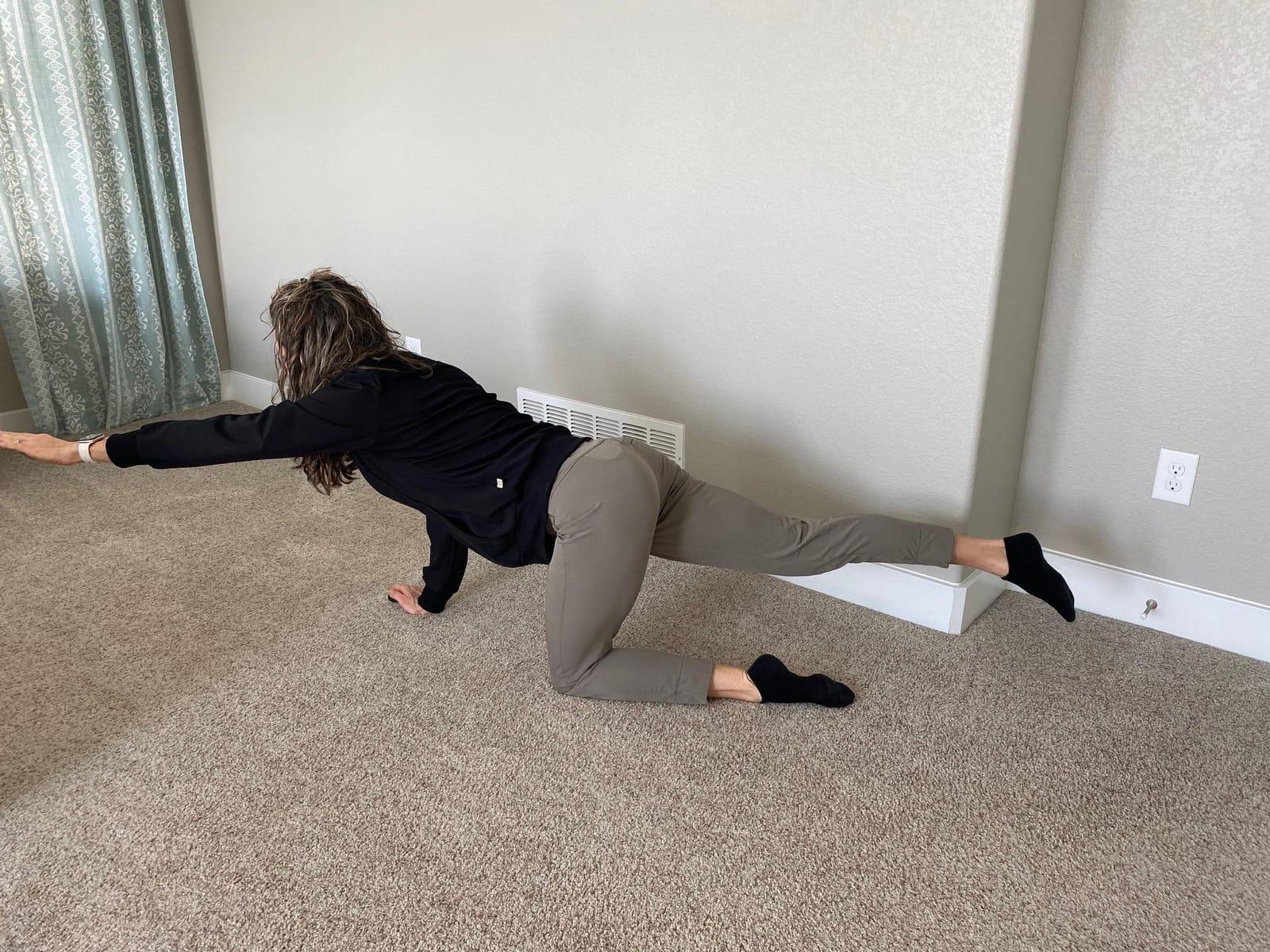
Bird-Dog
8–10 each side
- Start on your hands and knees, wrists under shoulders, knees under hips.
- Lift your right arm and left leg until they're straight, keeping your back flat and core engaged.
- Hold for a few seconds, lower, and repeat on the other side.
- Make it easier
- Lift only the leg, keeping both hands down.
- Make it harder
- Hold for 5 seconds before switching.
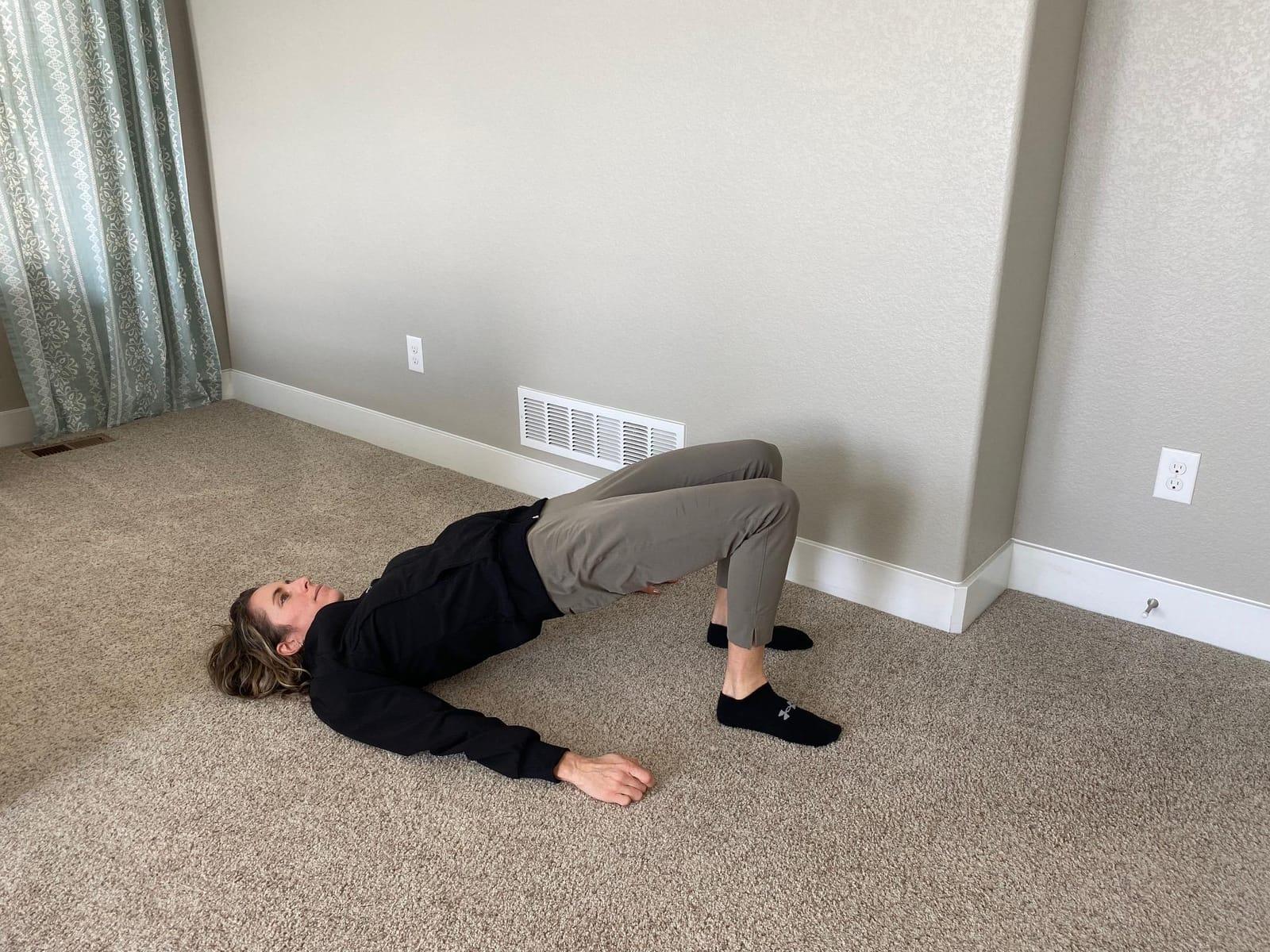
Glute Bridge
8–10, holding 5–10 seconds
- Lie on your back, knees bent, feet flat, arms at your sides.
- Press through your heels to raise your hips until your body forms a straight line from shoulders to knees.
- Squeeze your glutes, hold, then lower slowly.
- Make it easier
- Lift your hips only an inch or two.
- Make it harder
- Hold the bridge and march one foot off the floor at a time.
Side-Lying Leg Lift
8–10 each side
- Lie on your side with your head resting on your arm, hips stacked and the bottom knee bent.
- Keeping the top leg straight and your toes pointing forward, lift it toward the ceiling.
- Lower slowly. Do all your reps, then turn over.
- Make it easier
- Bend the bottom knee for more stability and make the lift smaller.
- Make it harder
- Pause at the top for 2 seconds, or add a light ankle weight.
Wall Slide
5–8, holding 5 seconds
- Stand with your back against a wall, feet about a foot in front of you and hip-width apart.
- Slowly slide down the wall, bending your knees as if starting to sit, keeping your knees over your toes.
- Hold, then press through your heels to slide back up.
- Make it easier
- Slide only a few inches down.
- Make it harder
- Slide a little lower and hold for 10–20 seconds.
Wall Push-Up
8–10, 2–3 rounds
- Stand a few feet from a wall and place your hands on it at shoulder height.
- Keeping your body in a straight line, bend your elbows to bring your chest toward the wall.
- Push back to the start with slow, controlled movement.
- Make it easier
- Stand closer to the wall.
- Make it harder
- Stand farther away, or use a sturdy counter instead of the wall.
To bring this into daily life, add the suitcase carry: carrying a bag in one hand teaches your core to keep you centered while you walk, which is exactly what it needs to do when you carry groceries.
How Do You Choose a Pilates Class?
- Look for an instructor experienced with older adults, and ideally with osteoporosis and joint replacements.
- Start with a beginner, gentle or "mature movers" class, and keep the class small enough that the instructor can watch your form.
- Tell the instructor about your health, especially low bone density, a joint replacement or back problems, and ask how they'll modify forward-bending moves.
- Notice how you feel afterward. You should feel worked, not sore in your joints or back.
Where Does Pilates Fit in Your Week?
A balanced week after 60 includes strength training on at least two days, balance practice, and aerobic activity like walking. Pilates can cover some of your balance and core work, and it's a lovely way to stretch. A week might look like this:
- Two or three days: strength training (legs, hips, back and arms, with resistance that keeps getting more challenging)
- One or two days: Pilates
- Most days: a walk, plus a few minutes of balance practice
Our guide to how much exercise seniors need has a full sample week. And if you'd like help putting it together, our trainers can build a program that includes the Pilates-style moves you enjoy, in your home in the Colorado Springs and Tri-Lakes area or online.
This guide is for general education and isn't medical advice. Please talk with your doctor before starting a new exercise, nutrition or supplement routine.
Read more from Kristen
Body · Recovery
Lower Back Pain Exercises for Seniors
Which kinds of back pain respond to exercise, when to see a doctor instead, and eight simple moves to strengthen and loosen a sore lower back.
February 1, 2025 · 6 min read

Body · Balance
Suitcase Carry: The Best Core Exercise for Real Life
The one-arm carry trains your core to keep you centered under uneven loads like groceries. Why it helps balance, and how to practice it safely at home.
January 10, 2026 · 2 min read
Body · Balance
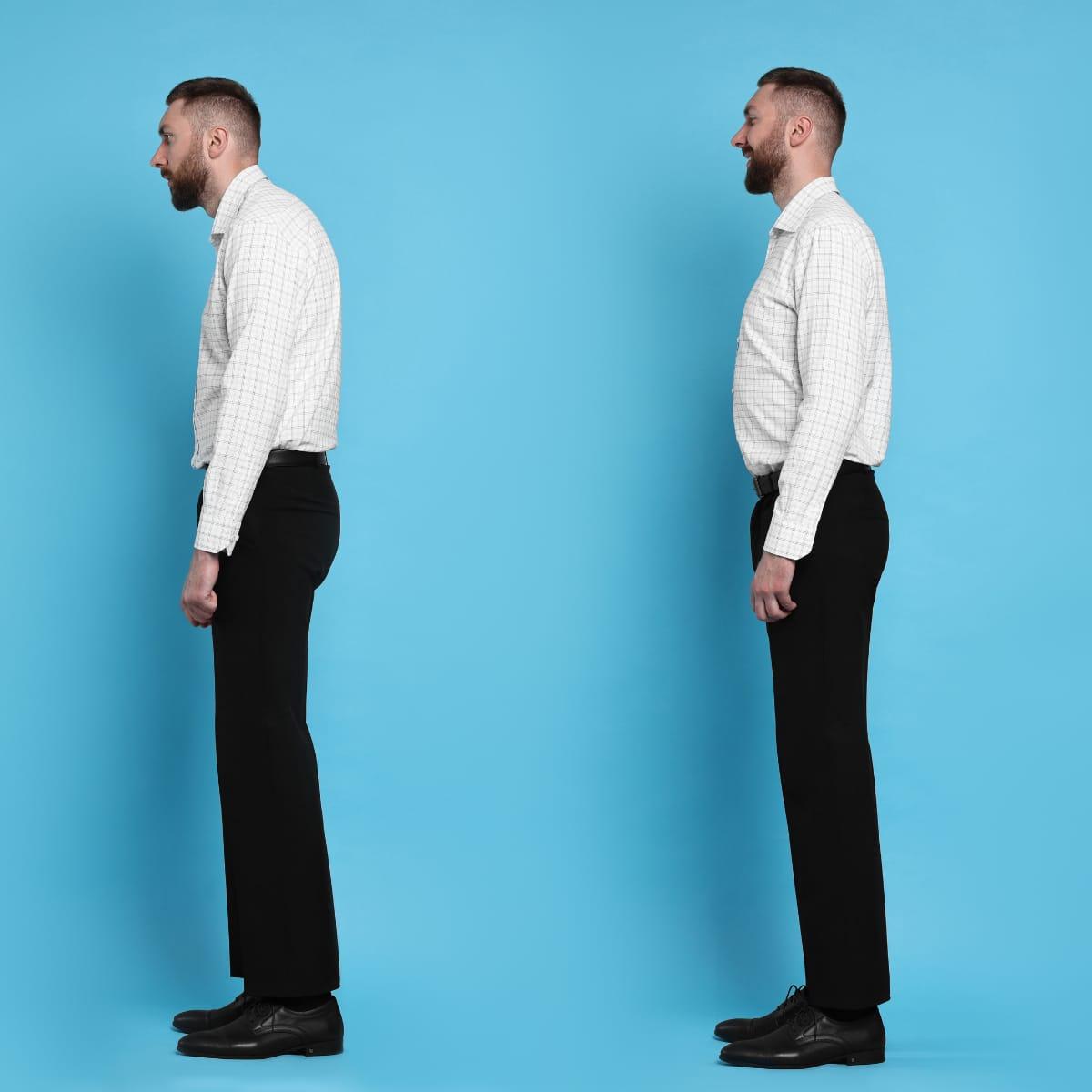
Posture Exercises for Seniors: Why Posture Matters
Good posture is about more than looks. It affects your balance, breathing and back. Try a quick arm-lift test, then five simple posture exercises.
January 11, 2025 · 5 min read
Body
How Strong Do You Need to Be to Stay Independent?
Staying independent takes more strength than today's tasks need. What a strength reserve is, 8 everyday tasks to check, and how to rebuild it after 60.
October 10, 2026 · 4 min read
Body
Which Exercises Build Bone Density? Weights vs. Walking
Resistance training, walking and impact exercise can slow bone loss and modestly build bone density. What works best, plus tips to stay motivated.
September 14, 2024 · 4 min read
Body
Why a Workout Partner Makes Exercise Easier
Sticking with exercise matters more than starting. Research on spouses, groups and supportive accountability shows why a workout partner helps.
October 18, 2025 · 3 min read
Frequently asked questions
Is wall Pilates good for seniors?
It can be a pleasant way to work your core, hips and legs with the wall for support, and the moves are easy to do at home. But wall Pilates hasn't been studied, so the big claims you see online aren't backed by research.
Treat it as a core and mobility workout, not a replacement for strength training, and skip the moves that curl your spine forward if you have osteoporosis.
Is reformer Pilates better than mat Pilates for older adults?
Each has advantages. The reformer's springs can add resistance and support, and classes are usually small and closely supervised. Mat Pilates needs no equipment, but it means getting down to the floor and back up, which is harder for some people.
Both have been used in research with older adults. Choose the one you can do safely and consistently, with an instructor who knows how to modify for your body.
Can Pilates replace strength training?
Not on its own. Reviews disagree on whether Pilates builds strength, it was no better than other exercise in the latest strength review, and it hasn't been shown to build bone. Keep 2–3 days a week of strength training with progressively heavier resistance, and enjoy Pilates as well.
How often should seniors do Pilates?
Most studies used two or three sessions a week for 8 weeks or longer. That's a good target, on days that fit around your strength training.
Sources
- Barker AL, Bird ML, Talevski J. Effect of pilates exercise for improving balance in older adults: a systematic review with meta-analysis. Arch Phys Med Rehabil. 2015;96(4):715-723. doi:10.1016/j.apmr.2014.11.021 View source
- Moreno-Segura N, Igual-Camacho C, Ballester-Gil Y, Blasco-Igual MC, Blasco JM. The effects of the Pilates training method on balance and falls of older adults: a systematic review and meta-analysis of randomized controlled trials. J Aging Phys Act. 2018;26(2):327-344. doi:10.1123/japa.2017-0078 View source
- Fernández-Rodríguez R, Álvarez-Bueno C, Ferri-Morales A, Torres-Costoso A, Pozuelo-Carrascosa DP, Martínez-Vizcaíno V. Pilates improves physical performance and decreases risk of falls in older adults: a systematic review and meta-analysis. Physiotherapy. 2021;112:163-177. doi:10.1016/j.physio.2021.05.008 View source
- de Campos Júnior JF, de Oliveira LC, Dos Reis AL, de Almeida LIM, Branco LV, de Oliveira RG. Effects of Pilates exercises on postural balance and reduced risk of falls in older adults: a systematic review and meta-analysis. Complement Ther Clin Pract. 2024;57:101888. doi:10.1016/j.ctcp.2024.101888 View source
- Oliveira LS, de Oliveira RG, da Silva TQ, Gonzaga S, de Oliveira LC. Effects of pilates exercises on strength, endurance and muscle power in older adults: systematic review and meta-analysis. J Bodyw Mov Ther. 2024;39:615-634. doi:10.1016/j.jbmt.2024.02.021 View source
- Markovic G, Sarabon N, Greblo Z, Krizanic V. Effects of feedback-based balance and core resistance training vs. Pilates training on balance and muscle function in older women: a randomized-controlled trial. Arch Gerontol Geriatr. 2015;61(2):117-123. doi:10.1016/j.archger.2015.05.009 View source
- Carrasco-Poyatos M, Ramos-Campo DJ, Rubio-Arias JA. Pilates versus resistance training on trunk strength and balance adaptations in older women: a randomized controlled trial. PeerJ. 2019;7:e7948. doi:10.7717/peerj.7948 View source
- de Oliveira RG, Anami GEU, Coelho EA, de Oliveira LC. Effects of Pilates exercise on bone mineral density in postmenopausal women: a systematic review and meta-analysis. J Geriatr Phys Ther. 2022;45(2):107-114. doi:10.1519/JPT.0000000000000309 View source
- Sinaki M, Mikkelsen BA. Postmenopausal spinal osteoporosis: flexion versus extension exercises. Arch Phys Med Rehabil. 1984;65(10):593-596. View source
- Bone Health & Osteoporosis Foundation. Proper body alignment. View source
This guide is for general education and isn't medical advice. Please talk with your doctor before starting a new exercise, nutrition or supplement routine. See our health disclaimer.

About the author
Kristen Nielsen
Kristen founded TogetherWON after watching what strength training could do for older adults — including her own grandparents. She's an ACE Certified Personal Trainer with 10+ years in functional aging, a University of Central Florida graduate, and a former Division I swimmer and track & field athlete.
Senior Fitness Specialist · Functional Aging Specialist · Parkinson's Disease Specialist · Brain Health Trainer · Corrective Exercise Specialist
want these in your inbox?
Get my Saturday letters
One idea for your body, brain or balance each week, usually with a recipe. Unsubscribe any time.