When Do Muscles Get Stronger? Not During the Workout
By Kristen Nielsen, Founder & Senior Fitness Specialist
· Recovery & Body · 4 minute read

Part of our guide: Recovery After 60: Rest, Sleep and Stress
Key takeaways
- Muscles get stronger after a workout, not during it. The workout is the signal, and recovery is when your body repairs and rebuilds muscle.
- In a McMaster University study of men around 67, muscle building was still elevated 24 and 48 hours after a strength workout.
- Progress needs both enough challenge and enough recovery. Training hard every day without rest can leave you tired, sore and less capable in your next workout.
- Support recovery with enough protein and sleep and some time off for hard-worked muscles, and make sure your workouts actually challenge you.
When do muscles get stronger? In the hours and days after a workout, while your body repairs and rebuilds them. That makes recovery part of training, not a break from it. (Our guide to recovery after 60 covers rest days, sleep and stress.)
This may sound strange, but you don't actually get stronger while you're exercising. The workout is the challenge. It tells your body, "I need to be able to handle more than I can handle right now." Then, after the workout, your body begins the work of adapting to that challenge. That is where getting stronger happens.
What Happens in Your Muscles After a Workout?
Exercise is the signal. Recovery is the response.
When you strength train, you temporarily stress your muscles. Your body then responds to that stress by repairing and rebuilding so that, over time, you are better prepared to handle the challenge again.
We can actually see this happening in research. In one study from McMaster University, researchers looked at men who were about 67 years old and measured what was happening in their muscles after exercise. Following a resistance training workout, muscle protein synthesis, which is the process your body uses to build and repair muscle, was still elevated 24 and even 48 hours later.
In other words, the workout may be over, but your muscles are still responding to it.
That does not mean everyone needs exactly 48 hours between every workout. It does help illustrate something important, though. Recovery is not time when nothing is happening. It is part of the training process.
A good exercise program needs enough challenge to give your body a reason to change, and enough recovery to give your body the opportunity to change. If either side is missing, progress can stall.
Is More Exercise Always Better?
I think this can be especially confusing as we get older. Some people are afraid to challenge themselves enough because they assume exercise should always feel easy. Others go in the opposite direction and think that if three workouts are good, six must be twice as good.
Neither is necessarily true.
Your body needs to be challenged, but you do not need to exhaust yourself every day to make progress. Continually training hard without enough recovery can leave you feeling tired, unusually sore and less capable during your next workout.
The goal is not to see how much exercise you can tolerate. The goal is to give your body the right amount of work so it can adapt and become stronger.
Are You Giving Your Body What It Needs to Recover?
- Am I eating enough protein? Protein provides the building blocks your body uses to maintain and rebuild muscle, and older muscles need more of it.
- Am I getting enough sleep? Sleep plays an important role in physical recovery, energy and overall health.
- Am I allowing hard-working muscles some recovery time? You do not have to be completely inactive between workouts, but the same muscles do not need to be pushed hard every single day.
- Do I usually feel ready for my next workout? Some muscle fatigue or soreness can be normal. Constant exhaustion or soreness is not the goal, and it can be one of the signs of overtraining.
- Am I actually challenging my muscles when I train? Recovery only helps if there was enough of a training stimulus in the first place.
That last one matters. You can rest perfectly, eat plenty of protein and sleep eight hours a night, but if your muscles are never being asked to do more, they have very little reason to become stronger.
Think of Training as a Cycle
Challenge → Recover → Adapt → Challenge Again
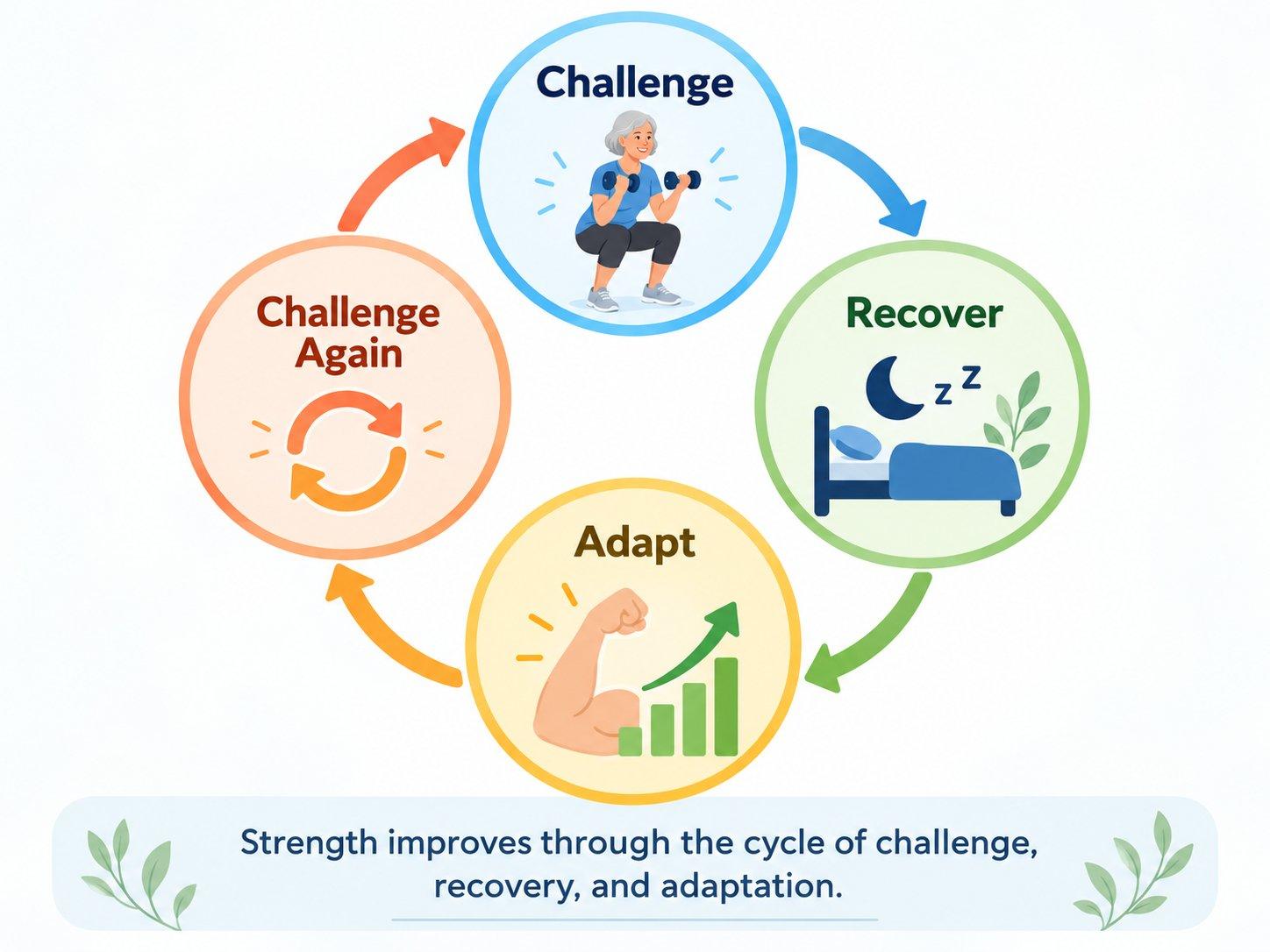
Over time, that cycle is what allows you to lift a little more, stand from a chair more easily, climb stairs with less effort and have more strength available for everyday life.
Recovery also does not mean sitting on the couch for days after every workout. Walking, normal daily activity and gentle movement can all be part of recovery. It simply means recognizing that your body needs time and resources to respond to the work you have asked it to do.
Work Hard Enough. Then Let Your Body Do Its Job.
As we get older, strength training becomes increasingly important, but that does not mean we need to exercise harder and harder every day. We need the right challenge, repeated consistently, with enough recovery in between.
The workout starts the process, but you do not get stronger during the workout. You get stronger because your body adapts afterward.
Kristen
Try the recipe: For an easy high-protein breakfast or snack, top Greek yogurt with this homemade granola — get the recipe.
Sources
- Bell KE, Séguin C, Parise G, Baker SK, Phillips SM. Day-to-day changes in muscle protein synthesis in recovery from resistance, aerobic, and high-intensity interval exercise in older men. J Gerontol A Biol Sci Med Sci. 2015;70(8):1024-1029. doi:10.1093/gerona/glu313 View source
This article is for general education and isn't medical advice. Please talk with your doctor before starting a new exercise, nutrition or supplement routine. See our health disclaimer.


About the author
Kristen Nielsen
Kristen founded TogetherWON after watching what strength training could do for older adults — including her own grandparents. She's an ACE Certified Personal Trainer with 10+ years in functional aging, a University of Central Florida graduate, and a former Division I swimmer and track & field athlete.
Senior Fitness Specialist · Functional Aging Specialist · Parkinson's Disease Specialist · Brain Health Trainer · Corrective Exercise Specialist
want these in your inbox?
Get my Saturday letters
One idea for your body, brain or balance each week, usually with a recipe. Unsubscribe any time.
Keep reading
Recovery · Body
Overtraining After 60: 5 Warning Signs and When to Stop
Five warning signs of overtraining after 60, from lingering fatigue to a higher resting heart rate, plus how to find balance and when to stop.
February 8, 2025 · 2 min read

Recovery · Body
How to Rebuild Strength After an Injury Over 60
Coming back from an injury after 60? Six steps to rebuild strength safely, from respecting healing time and easing back into load to using pain as a guide.
July 12, 2025 · 3 min read
Recovery · Body
Why Rest Days Make You Stronger: Hard and Easy Days
Plan 1–2 rest days a week. What happens in your muscles while you rest, and how alternating hard and easy workout days keeps you getting stronger.
December 21, 2024 · 3 min read