Gaze Stability Exercise for Better Balance and Focus
By Kristen Nielsen, Founder & Senior Fitness Specialist
· Updated · Balance & Brain · 3 minute read
Part of our guide: Balance Exercises for Seniors: How to Prevent Falls
Key takeaways
- A gaze stability exercise like Gaze Shifts with Thumbs trains your eyes and inner ear to work together, which can help your balance, and it takes just a minute once or twice a day.
- For Gaze Shifts with Thumbs, hold your thumbs about 8 inches apart and shift your focus between them as you slowly lower and raise your chin.
- Start slowly, then add a little speed or try it seated, standing or on one foot as your coordination improves.
A gaze stability exercise trains your eyes and inner ear to keep your vision steady while your head moves, and that coordination is a big part of balance. My favorite simple one is Gaze Shifts with Thumbs, which you can do anywhere.
When we think about balance exercises for seniors, we often picture strong legs and a steady core. But your eyes play a key role in how well you move, react, and stay upright.
Every time you walk across a room, turn your head, or track a moving object, your eyes and inner ear are working together to keep your world stable. When that coordination weakens — often with age or inactivity — it can lead to dizziness, blurred vision, or loss of balance.
That's where gaze-shifting exercises come in.
Do Gaze Stability Exercises Improve Balance?
Research suggests they can. Researchers have found that gaze stability and gaze-shifting drills can retrain the connection between your eyes, brain, and body. These exercises help your vestibulo-ocular reflex (VOR) — the reflex that keeps your vision clear while your head moves — work more efficiently.
Here are a few examples of what studies have shown:
- A 2024 study in Medicine found that stroke survivors who practiced gaze-stability exercises improved balance, gait, and confidence while walking compared to those doing standard balance work alone.
- Vestibular rehabilitation research (see more vestibular balance exercises) shows that gaze exercises can reduce dizziness and improve visual clarity during head motion, by helping the brain recalibrate eye-head coordination.
- Other trials, going back to at least 2003, using "gaze shift" training — alternating focus between near and far or side-to-side targets — show measurable improvements in dynamic visual acuity (your ability to see clearly while moving).
In simple terms: when your eyes and head move together in a trained, deliberate way, your body learns to stabilize more effectively in motion.
How Do You Do the Gaze Shifts With Thumbs Exercise?
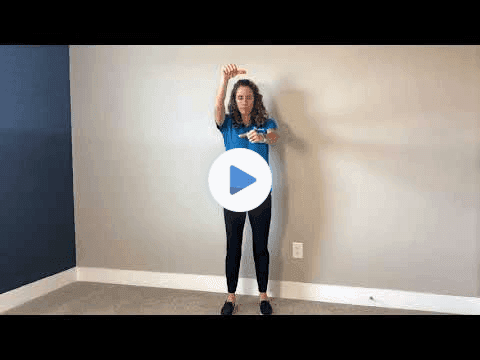
Hold your thumbs about 8 inches apart and shift your focus between them as you slowly lower and raise your chin. In the video below, I walk you through a simple but powerful version of gaze-shifting you can do anywhere.
How to do it:
- Extend your arms out in front of you with both thumbs up — one above the other, about 8 inches apart.
- Focus on the top thumb. While keeping your eyes locked on it, slowly bring your chin down as far as you can.
- With your chin down, shift your gaze to the bottom thumb.
- Keeping your eyes on the bottom thumb, lift your chin back up.
- Repeat this smooth up-and-down pattern several times.
You'll quickly notice how this challenges your ability to keep the visual world steady while your head moves. Over time, this helps improve eye-head coordination, balance, and even your sense of spatial awareness.
Watch the Gaze Shifts with Thumbs video on YouTube
Why Your Eyes Matter for Balance and Fall Prevention
Your visual system is deeply tied to your balance and brain function.
By adding small drills like this into your weekly routine, you're not only protecting your coordination — you're keeping the neural pathways that connect your eyes, inner ear, and muscles strong and responsive.
Whether you're playing pickleball, walking on uneven ground, or just standing up quickly, training your gaze system helps your brain process motion smoothly — reducing dizziness, hesitation, and falls.
How Often Should You Do Gaze Stability Exercises?
Practice "Gaze Shifts with Thumbs" once or twice a day. Start slow and steady.
As your coordination improves, you can increase the speed slightly or practice in different positions — seated, standing, or even while balancing on one foot. If dizziness or unsteadiness is holding you back, this is the kind of work we do in fall prevention and balance training.
Your eyes are more powerful than you think. Let's train them to move with purpose.
Kristen
Try the recipe: These lemon-dill salmon cakes are simple, protein-rich and full of nutrients that support brain and eye health — get the recipe.
Sources
- Cui Z, Tang YY, Lee MH, Kim MK. The effects of gaze stability exercises on balance, gait ability, and fall efficacy in patients with chronic stroke: a 2-week follow-up from a randomized controlled trial. Medicine (Baltimore). 2024;103(32):e39221. View source
- McDonnell MN, Hillier SL. Vestibular rehabilitation for unilateral peripheral vestibular dysfunction. Cochrane Database Syst Rev. 2015;1:CD005397. View source
- Herdman SJ, Schubert MC, Das VE, Tusa RJ. Recovery of dynamic visual acuity in unilateral vestibular hypofunction. Arch Otolaryngol Head Neck Surg. 2003;129(8):819-824. View source
This article is for general education and isn't medical advice. Please talk with your doctor before starting a new exercise, nutrition or supplement routine. See our health disclaimer.


About the author
Kristen Nielsen
Kristen founded TogetherWON after watching what strength training could do for older adults — including her own grandparents. She's an ACE Certified Personal Trainer with 10+ years in functional aging, a University of Central Florida graduate, and a former Division I swimmer and track & field athlete.
Senior Fitness Specialist · Functional Aging Specialist · Parkinson's Disease Specialist · Brain Health Trainer · Corrective Exercise Specialist
want these in your inbox?
Get my Saturday letters
One idea for your body, brain or balance each week, usually with a recipe. Unsubscribe any time.
Keep reading
Brain · Balance
Dual-Task Walking Exercises: Train to Walk and Think
Dual-tasking, or moving while thinking, can get harder with age, but it can be trained. Try three simple exercises that pair walking with a mental task.
August 1, 2026 · 3 min read
Balance · Brain
Vestibular Balance Exercise: Head Turns on One Foot
Your inner ear's vestibular system keeps you steady, and it's trainable. Try head turns on one foot to sharpen gaze stability and balance.
November 15, 2025 · 2 min read
Brain · Body
Music and Movement: A Brain-Body Workout to a Song
Pick a favorite song and let it set your pace. This simple music-and-movement workout challenges your brain and body at any fitness level.
September 12, 2026 · 2 min read