Can You Get Stronger at 82? Pat's BFR Training Results
By Kristen Nielsen, Founder & Senior Fitness Specialist
· Updated · Stories & Body · 4 minute read
Part of our guide: Strength Training for Seniors: The Complete Guide
Key takeaways
- Yes. Over 7 weeks and 13 BFR sessions, 82-year-old Pat got stronger in every measured category, including a 316.7% gain on the leg press.
- Blood flow restriction (BFR) training uses a cuff that gently limits blood flow during light exercise, challenging muscles without heavy, joint-straining weights.
- Pat gained strength in a previously injured shoulder and better leg endurance; BFR did not improve his knee arthritis, but it did not make it worse either.
- BFR is not right for everyone, so medical history is screened first and medical clearance may be recommended.
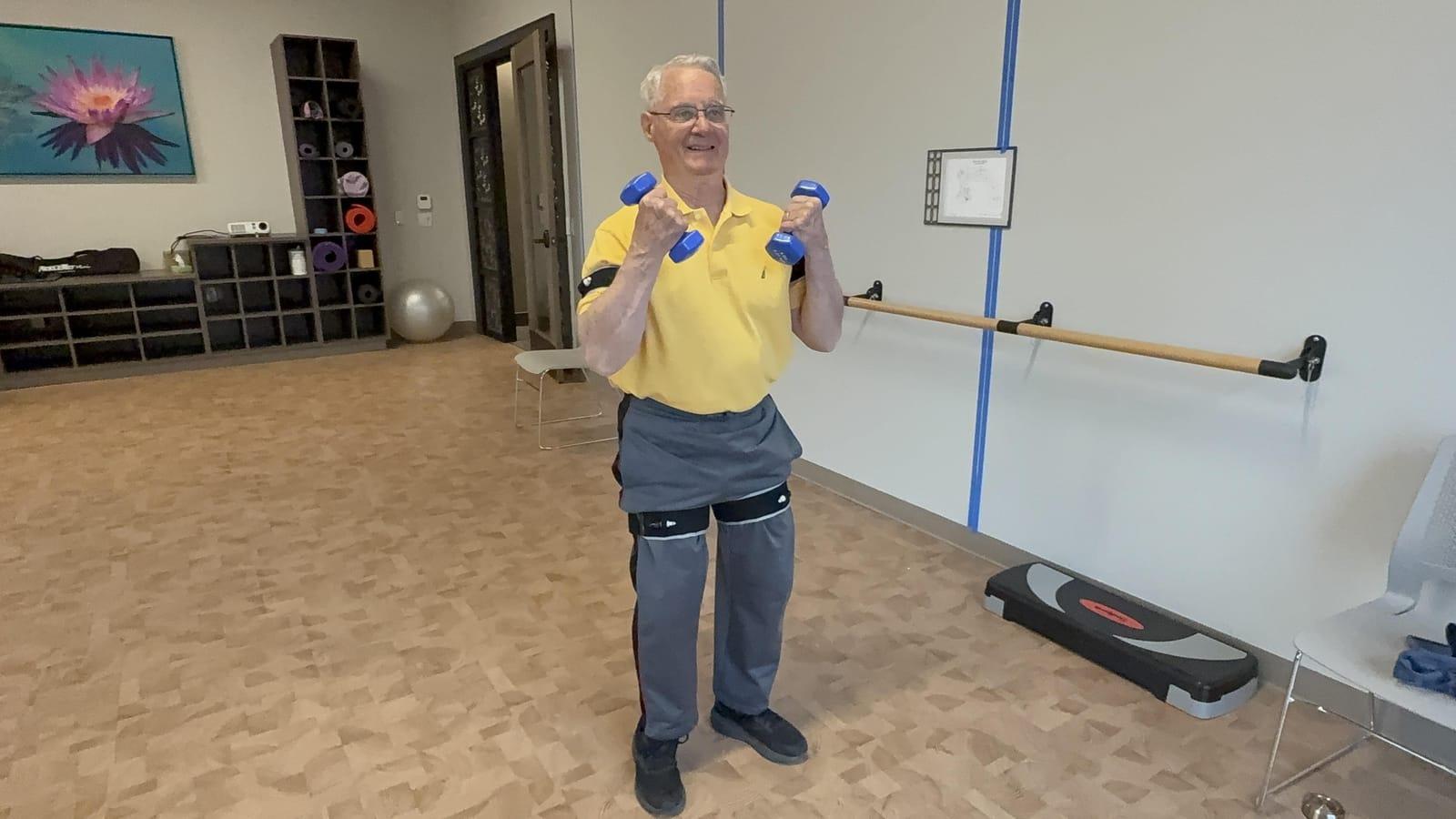
Yes, you can get stronger at 82. My client Pat did it with light weights and blood flow restriction (BFR) training, and his results show why strength training for seniors pays off at any age.
At 82 years old, Pat is still curious about what his body can do.
He is an active adult who enjoys learning new ways to support his health and fitness, so when he heard about Blood Flow Restriction training, often called BFR, he was interested in giving it a try.
Over 7 weeks, Pat completed 13 BFR sessions with me. What happened next was encouraging: he improved in every measured category, gained visible muscle definition in his arms, built strength in a previously injured shoulder, and noticed better endurance in his legs.
That is one of the reasons I'm excited that we offer BFR training at TogetherWON.
What Is BFR Training?
BFR uses a specialized cuff placed on the arm or leg during exercise. The cuff gently limits blood flow while the person performs light resistance movements. This creates a strong muscle-building signal while using much lighter resistance than traditional heavy strength training. I explain more in what is BFR training?
That's what makes it especially interesting for older adults.
Many of the adults I work with want to get stronger, but heavy lifting is not always the best or most comfortable option. Joint pain, arthritis, previous injuries, surgery history, or general deconditioning can make traditional strength training more challenging.
BFR is not right for everyone. But for the right person, it can be a helpful way to challenge the muscles while keeping the exercises lower-load and more joint-friendly.
Pat's BFR Training Results
Over the course of 13 BFR sessions, each lasting about 40 minutes, Pat and I worked on a combination of upper- and lower-body exercises, including sit-to-stands (the same movement as the chair stand test), leg extensions, leg curls, suspension rows, wall presses, curls, overhead presses, and hand grip squeezes.
His results were very encouraging.
Pat improved across every measured category, with the biggest gains showing up in strength-endurance and work capacity. His strongest improvements included:
- Leg press: +316.7%
- Left overhead press: +400%
- Seated row: +125%
- Right overhead press: +100%
- Chest press: +87.5%
- Left grip strength: +21.8% (you can check your own with our grip strength test)
What stood out to me most was not just that Pat got stronger. It was that he was able to complete far more repetitions with the same or slightly higher resistance.
That matters because daily life does not usually require one single maximum effort. It requires the ability to keep going — to climb stairs, get out of chairs, walk longer, carry things, and move with confidence throughout the day.
Pat also noticed visible muscle growth and definition in his arms. One of the most meaningful wins was that he gained strength in a shoulder that had previously been injured and had been difficult to strengthen. He also noticed improved endurance in his legs.
I also want to be honest about what BFR did not do. Pat has osteoarthritis in his knee, and the BFR training did not improve that arthritis. However, it also did not exacerbate it. For someone dealing with knee arthritis, being able to train the legs and improve endurance without making the knee worse is still a meaningful outcome.
Can Older Adults Still Build Muscle?
Yes. One of the things I love about working with older adults is that the body can still adapt. Strength can still improve. Muscle can still respond. Confidence can still grow.
Pat's results are a great example of that.
At 82, he made measurable strength gains, improved endurance, and saw changes in muscle definition. That is not because we pushed recklessly or tried to prove a point. It happened because we used a thoughtful method, tracked progress, and worked within what his body could tolerate.
As we age, building and maintaining muscle becomes increasingly important. Strength supports balance, walking, stair climbing, getting out of chairs, carrying groceries, and staying independent.
But not everyone needs to train the same way.
For some people, traditional strength training works very well. For others, especially those dealing with joint pain, previous injuries, or difficulty tolerating heavier loads, BFR may offer a useful bridge. It allows us to challenge the muscles without relying only on heavy weights.
Is BFR Right for Everyone?
No. BFR training needs to be used carefully and thoughtfully.
Before using BFR, we screen medical history. When needed, we also recommend medical clearance before beginning.
For most people, BFR can be a valuable addition to a personalized strength program.
Pat's results remind me why I'm excited to offer this tool. It gives us one more way to help adults build strength, protect independence, and keep doing the things they care about.
If you're curious whether BFR training may be a good fit for you or someone you love, feel free to reach out. I'd be happy to talk through whether it makes sense for your situation.
Kristen
Try the recipe: For a high-protein dinner, try this garlic herb cauliflower rice bowl with lemon chicken and a creamy yogurt sauce — get the recipe.
Sources
- Centner C, Wiegel P, Gollhofer A, König D. Effects of blood flow restriction training on muscular strength and hypertrophy in older individuals: a systematic review and meta-analysis. Sports Med. 2019;49(1):95-108. View source
- Fragala MS, Cadore EL, Dorgo S, et al. Resistance training for older adults: position statement from the National Strength and Conditioning Association. J Strength Cond Res. 2019;33(8):2019-2052. View source
This article is for general education and isn't medical advice. Please talk with your doctor before starting a new exercise, nutrition or supplement routine. See our health disclaimer.


About the author
Kristen Nielsen
Kristen founded TogetherWON after watching what strength training could do for older adults — including her own grandparents. She's an ACE Certified Personal Trainer with 10+ years in functional aging, a University of Central Florida graduate, and a former Division I swimmer and track & field athlete.
Senior Fitness Specialist · Functional Aging Specialist · Parkinson's Disease Specialist · Brain Health Trainer · Corrective Exercise Specialist
want these in your inbox?
Get my Saturday letters
One idea for your body, brain or balance each week, usually with a recipe. Unsubscribe any time.
Keep reading
Body · Stories
Building Muscle at 91: What a Sprinter Teaches Us
Researchers tested the muscles of a 91-year-old world-record sprinter. What they found shows why strength and power stay trainable as we age.
September 19, 2026 · 3 min read

Body · Stories
Staying Independent as You Age: Freedom Is Earned
The freedom to move independently is earned one workout, walk and set of stairs at a time. A Fourth of July reflection on effort and independence.
July 4, 2026 · 2 min read
Stories · Body
Senior Games Training: Why Having a Goal Motivates
Several TogetherWON athletes ran their first Senior Games races in 2026. Here's why having a goal, race or not, makes training more motivating.
June 20, 2026 · 2 min read