Is One Side Weaker? How to Fix Muscle Imbalances
By Kristen Nielsen, Founder & Senior Fitness Specialist
· Updated · Body & Balance · 5 minute read
Part of our guide: Strength Training for Seniors: The Complete Guide
Key takeaways
- To fix a muscle imbalance, notice which side does most of the work, then give your weaker side safe, successful practice, like supported weight shifts at the counter or training each side separately.
- Relying on your stronger side after an injury, surgery or inactivity can hide weakness and make the gap between your two sides even greater.
- For one day, notice which leg leads on the stairs, which hand carries heavier things, and whether both feet work evenly when you stand up.
- Sudden weakness, new numbness, significant pain or a recent change in walking should be checked by a qualified healthcare professional.
Most of us have a weaker side, and after an injury or a stretch of inactivity, leaning on the stronger one can quietly widen the gap. The fix is to notice the pattern and give the weaker side safe, successful practice, the same principle behind good strength training for seniors.
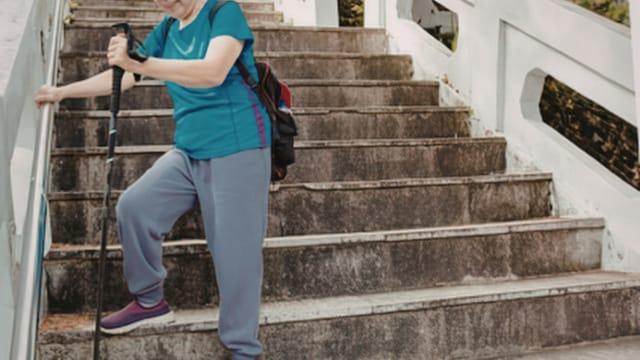
Without thinking about it, which leg do you use first when climbing stairs?
Which hand carries the groceries?
When you stand up from a chair, do you push harder through one foot?
Most of us have a dominant side. That is normal. But after an injury, surgery, arthritis flare-up, or period of inactivity, relying on the stronger side can become more than a preference. It can become a compensation pattern.
At first, this strategy is helpful. Your body finds the easiest way to complete the task.
The problem is that the easier way can gradually make the difference between your two sides even greater.
Why Does One Side Get Weaker?
One side often gets weaker simply because it gets less practice. Every time you favor one side, the stronger side receives another repetition while the weaker side misses one.
You may notice yourself:
- Pushing primarily through one leg to stand
- Leading every staircase with the same foot
- Shifting your weight away from a painful hip or knee
- Balancing almost entirely on one leg
- Carrying bags with the same arm
- Turning more comfortably in one direction
Over time, one side becomes more practiced, coordinated, and trusted. The other side becomes the one you avoid.
Studies involving older adults have found associations between side-to-side strength differences and measures such as gait quality, mobility, standing balance, and functional disability. However, asymmetry is not automatically dangerous, and researchers have not found that every strength difference predicts poorer function. The size, cause, and functional effect of the difference all matter.
Why Is a Muscle Imbalance Easy to Miss?
Muscle imbalances are easy to miss because you may still be able to complete the task.
You can still stand up — but your stronger leg is doing most of the work.
You can still climb the stairs — but only when you lead with the same foot.
You can still carry the laundry — but only on your preferred side.
The task looks successful, so the underlying weakness stays hidden.
It may become apparent only when life removes your usual strategy: the handrail is on the opposite side, you need to step up with the other foot, or you lose your balance in an unfamiliar direction.
Do You Have a "Trust Gap"?
Sometimes the issue is not strength alone. It is also confidence and coordination.
You may technically have enough strength in the weaker leg, but your brain no longer trusts it. As a result, you move away from that side quickly, hesitate before stepping onto it, or keep your weight centered over the stronger leg.
That creates a trust gap: one side is automatically assigned the work, while the other is treated as unreliable.
The solution is not simply to force yourself onto the weaker side. Pain, joint damage, neurological conditions, and surgical precautions (for example, during joint replacement recovery) can all affect how safely the two sides should be trained.
Instead, the goal is to give the weaker side appropriate, successful practice.
How Can You Tell If One Side Is Weaker?
The simplest way to tell is to watch yourself. For one day, pay attention to how you perform ordinary tasks:
- Which foot do you place forward before standing?
- Which leg leads going up and down stairs?
- Where does your weight shift while brushing your teeth?
- Which hand carries heavier objects?
- Which direction feels easier when turning?
- Can you stand from a chair with both feet contributing evenly? (The 30-second chair stand test is a good place to watch for this.)
You do not need perfect symmetry. Human bodies are not perfectly matched, and they do not need to be.
You are looking for a consistent pattern in which one side does nearly everything.
How Do You Strengthen Your Weaker Side?
You strengthen your weaker side by giving it a job it can succeed at. Depending on your ability and medical history, simple options might include:
During sit-to-stands: Place both feet evenly and notice whether you shift toward one side. Begin by making the movement more centered rather than deliberately overloading the weaker leg.
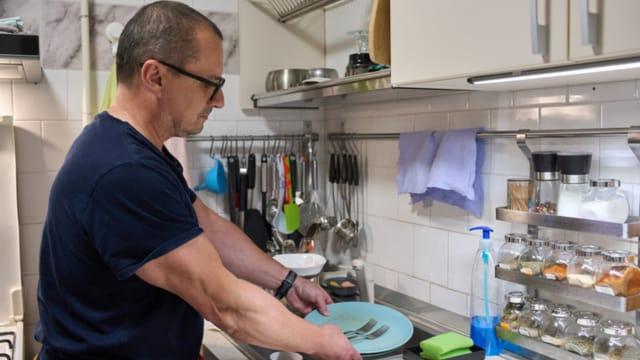
At the kitchen counter: Practice small, supported weight shifts toward the less-trusted side.
With step-ups: Use a low step and sturdy support, allowing the weaker leg to perform a manageable amount of work.
While carrying light objects: Occasionally use the non-dominant hand when it is safe to do so. A one-sided suitcase carry trains this on purpose, and a grip strength test on each hand can show whether one side lags.
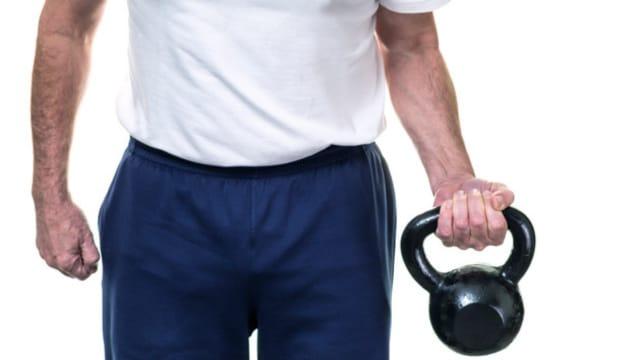
During strength exercises: Train each side separately when appropriate so the stronger side cannot quietly take over.
Older adults benefit from including both muscle-strengthening and balance activities in a regular exercise routine. The challenge should be appropriate to the individual rather than simply making every task harder.
Stronger Is Helpful. Overdependence Is Not.
Your stronger side is not the enemy. It may have helped you remain mobile through pain, weakness, or recovery.
But it should not have to do everything.
A capable body needs options.
It needs to step with either foot, turn in either direction, reach with either hand, and shift weight without immediately retreating to one preferred side.
The next time you stand, climb a step, or carry something across the room, pause for a moment.
Ask yourself:
Am I choosing my stronger side — or am I no longer giving the other side a chance?
That small observation may reveal an important part of your body that is ready to be trained again.
One very important thing to note: Sudden weakness, new numbness, significant pain, or a recent change in walking should be evaluated by a qualified healthcare professional rather than treated as a simple strength imbalance.
Kristen
Try the recipe: A smoothie can be an easy breakfast when you want something quick but still need enough protein to support muscle strength — get the recipe.
Sources
- LaRoche DP, Cook SB, Mackala K. Strength asymmetry increases gait asymmetry and variability in older women. Med Sci Sports Exerc. 2012;44(11):2172-2181. View source
- Portegijs E, Sipilä S, Alen M, et al. Leg extension power asymmetry and mobility limitation in healthy older women. Arch Phys Med Rehabil. 2005;86(9):1838-1842. View source
- Skelton DA, Kennedy J, Rutherford OM. Explosive power and asymmetry in leg muscle function in frequent fallers and non-fallers aged over 65. Age Ageing. 2002;31(2):119-125. View source
- Collins K, Johnson N, Klawitter L, et al. Handgrip strength asymmetry and weakness are differentially associated with functional limitations in older Americans. Int J Environ Res Public Health. 2020;17(9):3231. View source
- Piercy KL, Troiano RP, Ballard RM, et al. The Physical Activity Guidelines for Americans. JAMA. 2018;320(19):2020-2028. View source
This article is for general education and isn't medical advice. Please talk with your doctor before starting a new exercise, nutrition or supplement routine. See our health disclaimer.


About the author
Kristen Nielsen
Kristen founded TogetherWON after watching what strength training could do for older adults — including her own grandparents. She's an ACE Certified Personal Trainer with 10+ years in functional aging, a University of Central Florida graduate, and a former Division I swimmer and track & field athlete.
Senior Fitness Specialist · Functional Aging Specialist · Parkinson's Disease Specialist · Brain Health Trainer · Corrective Exercise Specialist
want these in your inbox?
Get my Saturday letters
One idea for your body, brain or balance each week, usually with a recipe. Unsubscribe any time.
Keep reading
Body · Balance
What to Add to Your Walking Routine After 60
Walking is a great foundation after 60, but it doesn't train everything. How to add strength, balance and brain-body work to your walks.
July 25, 2026 · 5 min read
Body · Balance
3 Common Exercise Mistakes Older Adults Make
Doing only cardio, skipping balance work and training at the wrong intensity are three common exercise mistakes after 60. Here's what to do instead.
February 7, 2026 · 3 min read

Body · Balance
Suitcase Carry: The Best Core Exercise for Real Life
The one-arm carry trains your core to keep you centered under uneven loads like groceries. Why it helps balance, and how to practice it safely at home.
January 10, 2026 · 2 min read